Showing posts with label 19th Century. Show all posts

Monday, 6 February 2017

Review of 'Coelebs in Search of a Wife' by Hannah More

Review of 'Coelebs in Search of a wife' by Hannah More

It's a bit scary that some people still adhere to the beliefs within this statement, which was written over 200 years ago. As you can probably guess, I wasn't the greatest fan of the morals set out within this novel, but yet I wasn't the least fan of it either. It's set worlds apart from the modern day, and despite this quotation being largely negative, it was actually seen as a feminist novel in its heyday. 

It largely looks at how to parent young girls, which was a bit of a risky topic back then, as it is now. Coelebs is looking for a wife (as you may have guessed), but every woman he comes across is too 'something'; they're too religious, or too dowdy, or too loose in their morals, or spend too much time reading novels (whoops). 

Coelebs' dying father asks him to spend some time with an old friend, Mr Stanley, after he passes away. Coelebs does this and is struck with the wonderful way in which Stanley raises his children, in particular his eldest Lucilla. They are taught from a young age that, though they are a family of means, the girls must do charitable work for the goodness of doing it, not for any praise or reward. They raise their own garden together, and sell the flowers they produce to raise money for the infirm in their area, or give the flowers for the poor to sell themselves. They are taught all aspects of domestic life and come to love them, as well as being competent in other pursuits such as singing and instrument playing.

All in all, Coelebs begins to see them as ideal women. And he falls in love with the eldest Lucilla, but does not know how to reveal this to her father. When he does, Mr Stanley tells Coelebs a tale that shocks and thrills him (as well as the reader)!

Have you read it? What did you think?

Friday, 17 June 2016

Review of 'A Tale of Two Cities' by Charles Dickens

Book review of 'A Tale of Two Cities' by Charles Dickens - www.the-darkness-will-never-win.blogspot.com

Okay, okay, I know I'm being one billion percent cliched here by not only reviewing a Dickens novel, but also using this quotation. However, as they say, in for a penny, in for a pound right? I'm a big lover of 19th century fiction (in case you hadn't gathered from my blog already), and I love to come back to the genre time and time again to find something new. Despite his general misogyny, Dickens does really have a piercing insight into the world of 19th Century class division, in a way in which the likes of Austen, or, god forbid even Hardy, never reaches.

A Tale of Two Cities moves between London and Paris during the upheavals involved with the French Revolution. However, as well as telling the story through the physical cities, Dickens also examines it through the love between Lucie Manette and Charles Darnay. 

Despite her French name, Lucie was brought up in London, an orphan, until she is met with the news that her father is in fact alive in Paris, and had been a prisoner in the Bastille. She heads to this other great city, retrieves her, by all means unwell, father and returns with him to London. Thereupon begins a great and tragic love story between her and Darnay. The one problem? He has a secret that encompasses both cities. A secret that Lucie's father keeps close to his chest, as he is the only one other than Charles that knows of it.

Charles was once a member of a great family, and escaped from France a few days before a law was passed sentencing all aristocratic emigrants to death upon their return to the country. He receives a letter informing him that one of his loyal servants has been captured for his misdeeds, and he is obliged to return in order to save him. From there, the little family face many trials and tribulations, and must escape a city that has struck an endless cry for blood.

I've read quite a number of Dickens' books, and here again we fall into the trap of women either being angels or demons. However, he does uphold the role they had to play in the falling of the Bastille and its aftermath; giving them some kind of political standing. As always the novel was filled with twists and turns that kept you wanting more and more. For once however, we weren't overrun with myriads of new characters, but rather were privy to a depth of character exploration often unseen in Dickens' work. 

I have previously studied the French Revolution in fairly great depth, so it was truly interesting for me to see the opinions of a Londonite author about the happenings in France. According to historians, it is pretty unlikely that Dickens headed to France himself during this period, which means that the interpretation we get in the novel runs off of rumours and news stories circulating London during this period. This does not however make the novel any less interesting, as it shows the general opinion of London at this time.

Have you read A Tale of Two Cities? What did you think?


Saturday, 11 April 2015

Review of "The Woman Who Did"

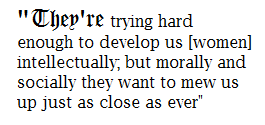
It really is very disturbing how little progress we've made in the face of feminism when you read a text like this that was produced over 100 years ago (published in 1895). The quotation above reflects a number of issues women are getting increasingly concerned about, in that they are having to now be recognised in an academic manner, but often have their behaviour proscribed to them in a moral and social sense. One only has to think about recent anti-rape campaigns, which focus on women changing their behaviour rather than changing the behaviour of potential rapists, to see that we still have a long way to go.

Herminia, son of a prestigious religious father, has rather radical ideas about her future. Rather than marry for love, money, or social status, she wants to join a man of an intellectual equal with her in a perfect union which is not bound by the law. When she manages to do so, and convinces him that this relationship is the way forward, they conceive a child, which they hope will be the advent of a new type of woman and class, in which marriage is disdained and women are man's equal. However, when fever strikes and her man dies, Herminia realises that there were quite a number of flaws to her plan ....


Although it starts off rather optimistic about Herminia's ideals, this text soon becomes tragic and very dark. Herminia was way ahead of her time, and her ideals simply cannot cohere with the world she lives in. With the death of her partner comes financial independence, and as a heavily pregnant woman there is little she can do. A life of poverty is begun, in which she is treated as a tainted woman. Moreover, she casts a dark shadow onto the future of her daughter with the dubious state of the relationship she was conceived in.

Have you read it? What did you think?
Steph x 


Saturday, 28 February 2015

Review of "Out of Work"


You've probably noticed by now that a lot of the books I post about are, to put it lightly, a bit 'obscure'. However, I don't think this makes them any less valuable. As part of my course at university I get the opportunity to read a great number of texts that I otherwise would simply never come across, and although yes, I find some of them terribly dreary, a lot of them are incredibly eye opening. Take this book for example - written by John Law (Margaret Harkness) and published in 1888, it reads like a more easily understandable and shorter Dickens. As a lover of Dickens, I found this fabulous, especially as Law, unlike Dickens, manages to paint semi-realistic female characters! Also, it's full of thought-provoking quotations like the one above, which are alarming in that stereotypes along these lines are things that many girls and women of our generation have heard said to them in some way or another.

Polly Elwin lives alone with her mother and is engaged to be married to Jos, a young carpenter who has moved from the country to secure work. However, this proves harder than he had originally realised, and soon his decreasing funds loses him the respect of Polly's mother and he is no longer allowed to live in the house. Becoming more and more penniless, Jos comes across many issues in 19th C London, amongst them the possibility of a richer suitor seeking out his Polly ...


This book examines the poverty in London in the late 19th Century, alongside the riots it induced. Told from the perspective of an innocent man who is simply unlucky, the reader really gets to feel how inescapably consuming the problem of unemployment in England during this time was, and how helpless so many men felt. There was a great emphasis on the idea that a man had to earn a certain amount to be "worthy" of marriage, and this is one of the few texts one could regard as feminist from this time which i read that examines how destructive the ideals surrounding marriage at this time could be to men as well as women. Indeed, even the riots and the poverty of London is not only shown through Jos, but the women forced to sell their newborns for a matter of pence to keep the rest of the family alive, and so on.

Have you read it? What do you think of 19th century books about marriage?

Steph

Thursday, 18 December 2014

Book a Day | Day 18 Massive Tome


Let's be real, I haven't read this. BUT it is sat on my bookshelf every day, glaring at me and has been doing so for years. I will get to it, one day. 
The massive tome I really wanted to use was Bleak House, but I seem to have left my copy of it at uni. Check out my brief look into crime in Bleak House here

What's your choice?
Steph

Wednesday, 10 December 2014

Book-A-Day #10 | Latest Purchase


I had to choose this one because it's just so pretty! I must admit, apart from books for my course I probably haven't bought any books in the past two or three years (madness!). I recently bought this for one off my third year modules so have yet to read it. However, I'm a sucker for judging a book by a cover, so if this is not a quaint, pleasantly tea-filled novel I shall be disappointed!

What is your latest purchase?

Steph

Sunday, 30 November 2014

Review of "North and South"


As I'm a student with limited funds, buying all of my (literally hundreds over the course of my degree) books can rack up to become quite expensive. So, every year I take a trip down to an incredible secondhand bookshop in a small seaside town called Bognor Regis. This shop is genuinely my favourite place in the world - I could spend hours there. It's called The Paperback Exchange and works on the basis of you bringing books in to the store to buy secondhand books at a reduced rate. The prices are so crazy I've even got a couple of Shakespeare's in here for 20p! Books are rated on their quality, and I think this copy of North and South cost me about £1.20, but compared to the £7.99 it costs new, and the £2.81 it costs as a minimum on Amazon, this was a complete bargain! You can grab a copy yourself for £5.99 here

Over the last couple of years, I've read a fair amount of 19th Century fiction, some good (Wuthering Heights is still in my top ten) and some bad (Mansfield Park, I'm looking at you), but I have to say that North and South fits into the former category. It does something which most 19th Century authors seem to fail to do: create a believable heroine. It's also a book which I've found incredibly relevant to the modern woman, and feminist, as well to evaluating the way in which business owners currently see their employees.


Margaret Hale, the protagonist of the novel, has been living in high society in London with an aunt for a number of years. However, as her cousin Edith gets married and moves away, Margaret returns to her home in the idyllic country Hamlet of Helstone with her mother and father. Her father, a parson, begins to entertain doubts in his faith, which force him to give up his position in the village. Out of shame, and a lack of necessity for living there anymore, the family move to Milton, an industrial town in the North. Here, Margaret must learn a great deal about herself, as the town strikes her with many a tragedy. Class and gender become intractably embroiled as she becomes more and more integrated with the rough society of Milton.


Margaret Hale is truly an inspiring female character for the 19th Century novel. Unlike other "feminist" novels *cough* Coelebs (I think I still have nightmares about that one), North and South really examines what it means to be an independent woman. Margaret shows extreme strength of mind and body, at times proving that she is as powerful, if not more powerful, than several men in the novel, especially her father. She makes her own mind up as to who she will not marry, and does not let her decision be swayed by wanting motherhood or protection for the future. She also bears the greatest weight of emotional stress in the novel, as everyone seems to use her as a dumping ground for all of their problems. However, she does not faint and cry like Fanny or Edith would, but keeps going and gets done what is necessary to get done. Moreover, she engages with the class structure in an incredibly unique way. It is ultimately Margaret who ends the strike, by obstructing the path of the debris flung at Mr Thornton, and Margaret who leads to the working men being given luncheon by Mr Thornton. All in all, she is a powerful voice for change: her voice will be heard, she does have power over her own mind, and most importantly, she will not engage with the stereotypes of the woman of sensibility.

Have you read it? What did you think?

Steph