Showing posts with label poverty. Show all posts

Wednesday, 6 May 2015

Review of "Shifting Colours" + Summer Reading Goal


I've been looking for books with a little more depth behind them than the generic chick flick I always come back to (hey, everyone has their own guilty pleasures right?). As I'm almost at the end of my English lit degree, I'm no longer forced to read things I wouldn't necessarily pick up, and what's more, I don't have the time to read ones I've missed because of the impending doom that is finals. So, over summer I'm going to try and read one that I didn't get around to every couple of weeks so that I make sure I keep my reaching schedule varied! Plus, it'll be great to read without a deadline.

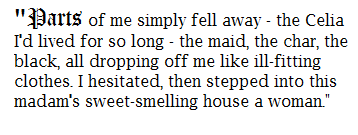
Celia, mother of three, must work as a maid in South Africa in order to sustain herself and her children, two of which live with their grandmother. Miriam, her youngest child, lives with her in the white family's house and Celia must care for this young girl whilst performing all of the duties expected of her. 

However, once Michael and Rita, Celia's employers, have a stillborn baby and realise that child bearing may not be a thing in their future, they begin to look at Miriam in a new light. Informed that they will take Miriam to England, and bring her up in an economically stable environment, or she be forced to find a new job and care for Miriam, Celia does what she feels is best for her child. Breaking her own heart, she hopes that Miriam will be happy. But, living in a predominantly white area and being outcast as an outsider at school in England, Miriam longs for home. As she grows older, Miriam realises she needs to find out more about her real identity, and begins a journey back to Africa. But, will there be more surprises than anticipated in Miriam's journey to self-awareness?


This wasn't the quickest page-turner for me, but as I said, it was good to read something with a little more depth to it. However, I'm someone who is oddly affected by the mood of a book, and so much of this was an endless depressing battering of any hope. This personally made it harder for me to want to come back to. And yes, I do get that books can't always be happy-go-lucky, but when the 17th thing in a row went wrong and smacked Celia or Miriam in the face I felt like flinging my kindle across the room. But, that's a miniscule percentage of the frustration that being in Celia or Miriam's position would have produced!

Have you read it? What did you think?
Steph x

Saturday, 28 February 2015

Review of "Out of Work"


You've probably noticed by now that a lot of the books I post about are, to put it lightly, a bit 'obscure'. However, I don't think this makes them any less valuable. As part of my course at university I get the opportunity to read a great number of texts that I otherwise would simply never come across, and although yes, I find some of them terribly dreary, a lot of them are incredibly eye opening. Take this book for example - written by John Law (Margaret Harkness) and published in 1888, it reads like a more easily understandable and shorter Dickens. As a lover of Dickens, I found this fabulous, especially as Law, unlike Dickens, manages to paint semi-realistic female characters! Also, it's full of thought-provoking quotations like the one above, which are alarming in that stereotypes along these lines are things that many girls and women of our generation have heard said to them in some way or another.

Polly Elwin lives alone with her mother and is engaged to be married to Jos, a young carpenter who has moved from the country to secure work. However, this proves harder than he had originally realised, and soon his decreasing funds loses him the respect of Polly's mother and he is no longer allowed to live in the house. Becoming more and more penniless, Jos comes across many issues in 19th C London, amongst them the possibility of a richer suitor seeking out his Polly ...


This book examines the poverty in London in the late 19th Century, alongside the riots it induced. Told from the perspective of an innocent man who is simply unlucky, the reader really gets to feel how inescapably consuming the problem of unemployment in England during this time was, and how helpless so many men felt. There was a great emphasis on the idea that a man had to earn a certain amount to be "worthy" of marriage, and this is one of the few texts one could regard as feminist from this time which i read that examines how destructive the ideals surrounding marriage at this time could be to men as well as women. Indeed, even the riots and the poverty of London is not only shown through Jos, but the women forced to sell their newborns for a matter of pence to keep the rest of the family alive, and so on.

Have you read it? What do you think of 19th century books about marriage?

Steph