Showing posts with label feminist. Show all posts

Saturday, 10 November 2018

Review of 'The Power' by Naomi Alderman

Review of 'The Power' by Naomi Alderman

The Power is a pick from my 2018 bucket list of things I *have* to get through before the end of the year (worringly I've got quite a few left still, considering we're in November!). It's something that I've wanted to read since it came out, and I had such high hopes for it that I was left feeling a little deflated. Don't get me wrong, it was a good book, and definitely an interesting read, but it just didn't quite hit the mark for me.

Saturday, 29 September 2018

Review of 'The Vagina Monologues' by Eve Ensler

Review of 'The Vagina Monologues' by Eve Ensler

Towards the start of 2018, I set myself a book bucket list of all the things I wanted to read this year. It's been a while since I read a play, and I kind of miss it, so The Vagina Monologues took pride of place as the only play on the list. I've heard amazing things about it, which made me worried that I'd be let down when I read it, but this was so far from the truth. 

The Vagina Monologues is one of the most thought-provoking things I've read all year. It made me reconsider my own body, the political landscape that my body fits in, and why we should celebrate all women's bodies. It brought things that I always knew deep down out into the open where I could really consider them. For instance: body hair and its politicisation. I know body hair is politicised, I know that women used to be happy to have body hair everywhere until razor companies started targeting us to double their profits (a true story). But, I'd forgotten how much stigma comes with any kind of body hair: pubes and you're dirty, armpit hair and you're a raging feminazi, no hair and you're no longer a virgin. And we never stop to think about the weird insistence on going back to this hairless childlike state, and why it's so appealing. 

This is just one of the topics that the book covers. It also looks at domestic abuse, sexual abuse, childbirth, masturbation, sex, etc, from a whole range of different perspectives. My one warning for this book is that if you're a victim of sexual assault, the monologues in this book may be triggering. 

I'm so grateful I read this, as it completely opened my eyes to a whole range of things. There was an incredible foreword by Gloria Steinem in my copy, which absolutely made the book ten times better and helped to explain the fundamental theories behind the monologues, and give them a bit more substance.

This book could be quite triggering, as previously mentioned, but I really do thing it's a very important thing for all genders to give a go, to understand the politics and depth of meaning behind the mighty vagina.

Have you read it? What did you think?

Follow me on Bloglovin | Twitter | Instagram | Youtube

Sunday, 18 March 2018

Review of 'The Handmaid's Tale' by Margaret Atwood

Review of 'The Handmaid's Tale' by Margaret Atwood

Let's kick start this by saying that this is the best/scariest/most profound book I've read in a LONG time. I mean, I always thought I'd like Margaret Atwood's work, but I never thought I'd find it this life altering. The Handmaid's Tale has made me think twice about everything I do. I feel like even more of an eco-warrior than I ever have been, and I'm absolutely petrified about the harm we're causing to our world, and to each other. 

The Handmaid's Tale is set in a dystopian future. In this world, all the plastic that we've dumped into the ocean has reduced the fertility of humans so much that the population is seriously declining (FYI, the whole plastic reducing fertility thing is something that's actually starting to happen). Modern consumerist society has been erased and replaced by a world filled with rations and re-using everything as much as we can. 

It's a world where everyone has their proper place in society, and people are ranked. Our narrator is a handmaid. She wears red and is effectively brought up to become a surrogate mother for an important man and his ageing wife. When handmaids stop being fertile, they go to the place everyone fears: the colonies. Here, women are forced to clear up nuclear waste, effectively signing their own death warrant.

As the novel progresses, the narrator is put in a series of very difficult situations, and there are so many twists and turns and heart racing moments for the reader. I found this book so moving because the handmaiden's personality absolutely shines through. Atwood doesn't let you forget that she's a person behind the status she's been given. She had a life before her world changed into this dystopia and she has desires and emotions just like us.

I want to read so much more from this author now, as this book was incredibly powerful. I would definitely recommend it if you want to read a (fairly) modern feminist novel.

Follow me on Bloglovin | Twitter | Instagram | Youtube

Tuesday, 6 June 2017

Review of 'Maria, or the Wrongs of Woman' by Mary Wollstonecraft

Review of 'Maria, or the Wrongs of Woman' by Mary Wollstonecraft

We've all heard of Mary Shelley's Frankenstein, but Shelley's mother's literary-political works are much less well-known. Today I'm going to be talking about one of them. Maria, or the Wrongs of  Woman is an early radical feminist novel, which unfortunately has no ending. There are several fragmentary endings, but none are complete or fully coherent, as the author died before she had finished the work; it was published posthumously by her husband. 

The novel commences with Maria in an asylum. Her husband has placed her in there, as she attempted to flee his control, and has seized her child. Maria is completely sane. The woman who waits on her, Jemima, soon comes to realise this, and sneaks books in for her to read. These she shares with a fellow inmate Dartford. He's been put in the asylum because of a night on which he drink far too much; he too is sane. The pair begin to communicate through writing on the margins of the texts they both read. 

Soon, Maria begins to fall for Dartford. He becomes more and more intrigued by her character and ultimately requests her to spell out her past to him. Maria's husband seemed like a wonderful man prior to their marriage, but she soon realises that he's a libertine. As well as spending all of their money with no cares, he repeatedly cheats on her. Maria draws further away from him, and the idea of having sex with him becomes abhorrent. He forces himself upon her and Maria gets pregnant. Things are getting worse and worse, and Maria knows she needs to get away, but the social climate simply won't allow it...

Have you read it? What did you think?

Saturday, 25 February 2017

Review of 'The Subjection of Women' by John Stuart Mill

Review of 'The Subjection of Women' by John Stuart Mill

John Stuart Mill is a name that has been bouncing around my ears for years. First he was a big figure on my A-Level Ethics course, and then he popped up again on my first-wave feminism studies module at uni. The Subjection of Women was first published back in 1869, and I imagined it would be so dry (read: Mary Wollstonecraft-esque) that I just skipped over reading it, but now that I've come back to it I can see how powerful it really is. 

The best (or worst?) thing about it, is that it lays out feminist goals in simple terms, and shows how little we've completely achieved. Mill calls for the social, political and economic equality of the sexes. And that's what we're still fighting for. He asks that marriage be determined on equal grounds: women should retain their own property and have the ability to be heirs in their own rights. 


The greatest focus of the essay is upon marriage, and as such he goes into great lengths about the equality of partners within marriage in the eyes of the law. He suggests that women ought to have the right to divorce a husband on the grounds of abuse, and that they ought to have hold over their own money.


This long essay went against much of European conventions at the time. Reading it from a modern perspective makes you notice how forward-thinking Mill was. Still we often have inequality within marriage: women are required by tradition to take a man's name, and often expected to bend to a man's will, like the quotation above suggests. 

Mill also defended the intelligence of women, making the logical claim that there would be more successful female scientists and mathematicians if as many women as men studied the subject. He disputed the argument that women have smaller brains and smaller intellects because of the size of their heads also. 

If you want to get to know more about first wave feminism I would definitely recommend not doing what I did and skipping over this, but going for it as it truly was very eye-opening.

Have you read this? What did you think?

Monday, 6 February 2017

Review of 'Coelebs in Search of a Wife' by Hannah More

Review of 'Coelebs in Search of a wife' by Hannah More

It's a bit scary that some people still adhere to the beliefs within this statement, which was written over 200 years ago. As you can probably guess, I wasn't the greatest fan of the morals set out within this novel, but yet I wasn't the least fan of it either. It's set worlds apart from the modern day, and despite this quotation being largely negative, it was actually seen as a feminist novel in its heyday. 

It largely looks at how to parent young girls, which was a bit of a risky topic back then, as it is now. Coelebs is looking for a wife (as you may have guessed), but every woman he comes across is too 'something'; they're too religious, or too dowdy, or too loose in their morals, or spend too much time reading novels (whoops). 

Coelebs' dying father asks him to spend some time with an old friend, Mr Stanley, after he passes away. Coelebs does this and is struck with the wonderful way in which Stanley raises his children, in particular his eldest Lucilla. They are taught from a young age that, though they are a family of means, the girls must do charitable work for the goodness of doing it, not for any praise or reward. They raise their own garden together, and sell the flowers they produce to raise money for the infirm in their area, or give the flowers for the poor to sell themselves. They are taught all aspects of domestic life and come to love them, as well as being competent in other pursuits such as singing and instrument playing.

All in all, Coelebs begins to see them as ideal women. And he falls in love with the eldest Lucilla, but does not know how to reveal this to her father. When he does, Mr Stanley tells Coelebs a tale that shocks and thrills him (as well as the reader)!

Have you read it? What did you think?

Saturday, 11 April 2015

Review of "The Woman Who Did"

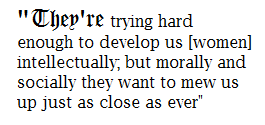
It really is very disturbing how little progress we've made in the face of feminism when you read a text like this that was produced over 100 years ago (published in 1895). The quotation above reflects a number of issues women are getting increasingly concerned about, in that they are having to now be recognised in an academic manner, but often have their behaviour proscribed to them in a moral and social sense. One only has to think about recent anti-rape campaigns, which focus on women changing their behaviour rather than changing the behaviour of potential rapists, to see that we still have a long way to go.

Herminia, son of a prestigious religious father, has rather radical ideas about her future. Rather than marry for love, money, or social status, she wants to join a man of an intellectual equal with her in a perfect union which is not bound by the law. When she manages to do so, and convinces him that this relationship is the way forward, they conceive a child, which they hope will be the advent of a new type of woman and class, in which marriage is disdained and women are man's equal. However, when fever strikes and her man dies, Herminia realises that there were quite a number of flaws to her plan ....


Although it starts off rather optimistic about Herminia's ideals, this text soon becomes tragic and very dark. Herminia was way ahead of her time, and her ideals simply cannot cohere with the world she lives in. With the death of her partner comes financial independence, and as a heavily pregnant woman there is little she can do. A life of poverty is begun, in which she is treated as a tainted woman. Moreover, she casts a dark shadow onto the future of her daughter with the dubious state of the relationship she was conceived in.

Have you read it? What did you think?
Steph x 


Saturday, 21 March 2015

Review of 'The Rover'

This is probably the oldest text I've ever read by a woman. I'm not going to lie, before coming across 17th Century English literature I didn't even know women were able to write published work at this kind of time (kind of shows how repressive some eras were - I'm looking at you, almighty damaging Victorian period). Anyway, The Rover, a play by Aphra Behn, is incredibly expressive regarding the wit and status of women in society during this period. However, this quotation, despite appearing a bit fluffy and cute is actually one of the most troubling I came across in the text. It's spoken by one of the boldest women in the play, Angellica, but suggests that there is an inherent weakness in women that emerges when they fall in love. 

Willmore, or the rover whom the name is titled after is looking for love (or sex, they're effectively the same thing in 17th C fiction). Hellena, whose brother simply wants to send her to a convent and preserve her feminine purity, seeks to get a glimpse into the real world and fall in love. Her and Willmore's paths and hearts meet, however, another figure comes into play: Angellica. Despite being a courtesan, albeit one who insists on a high payment, Angellica is actually not a 'simple' woman as one might expect her to be stereotyped. Amongst a number of other plot lines, you get to see whether Willmore will choose the simple, but alluring Hellena, or the stunning Angellica.

Have you read it? What did you think?

Steph x

Saturday, 28 February 2015

Review of "Out of Work"


You've probably noticed by now that a lot of the books I post about are, to put it lightly, a bit 'obscure'. However, I don't think this makes them any less valuable. As part of my course at university I get the opportunity to read a great number of texts that I otherwise would simply never come across, and although yes, I find some of them terribly dreary, a lot of them are incredibly eye opening. Take this book for example - written by John Law (Margaret Harkness) and published in 1888, it reads like a more easily understandable and shorter Dickens. As a lover of Dickens, I found this fabulous, especially as Law, unlike Dickens, manages to paint semi-realistic female characters! Also, it's full of thought-provoking quotations like the one above, which are alarming in that stereotypes along these lines are things that many girls and women of our generation have heard said to them in some way or another.

Polly Elwin lives alone with her mother and is engaged to be married to Jos, a young carpenter who has moved from the country to secure work. However, this proves harder than he had originally realised, and soon his decreasing funds loses him the respect of Polly's mother and he is no longer allowed to live in the house. Becoming more and more penniless, Jos comes across many issues in 19th C London, amongst them the possibility of a richer suitor seeking out his Polly ...


This book examines the poverty in London in the late 19th Century, alongside the riots it induced. Told from the perspective of an innocent man who is simply unlucky, the reader really gets to feel how inescapably consuming the problem of unemployment in England during this time was, and how helpless so many men felt. There was a great emphasis on the idea that a man had to earn a certain amount to be "worthy" of marriage, and this is one of the few texts one could regard as feminist from this time which i read that examines how destructive the ideals surrounding marriage at this time could be to men as well as women. Indeed, even the riots and the poverty of London is not only shown through Jos, but the women forced to sell their newborns for a matter of pence to keep the rest of the family alive, and so on.

Have you read it? What do you think of 19th century books about marriage?

Steph

Tuesday, 17 February 2015

Review of McTeague

I have a whole host of reviews lined up for you guys, and seen as I've actually done all my seminar reading for this week (for about the first time in, well, ever! Only took until final year ...) I'll be hopefully able to post a bit more often. Anyway, this book wasn't something I would necessarily have picked up off of the shelf myself. Written by Frank Norris and published in 1899, it holds an alarming number of ugly truths for our modern world. If you're looking for something that really investigates how human relationships are now interceded by money, gold and the trappings of wealth, this is your go-to. Plus, despite being written over a century ago, it's remarkably easy to read.


McTeague, a brute of a man, is a dentist who lives in his own dentist parlours. His large size and simple nature means that he rarely gets desirable clientele, that is, until his best friend Marcus brings his cousin Trina to the dentist's chair. Soon he comes to admire her, where before he could only admire his small collection of trinkets. However, is it even possible for this bear of a man to really "love" another being?


In the world of this book, everything relates to money and gold. you come to realise that all characters are in fact bound by the world of commodification and exchange - to the extent that other people almost become money in terms of their relationship to a person. Aside from this, which arguably questions our modern emphasis on owning things and valuing them in their commodified state, gender and sex are key issues in the text. Trina simultaneously fears McTeague, yet her desire for him increases as her fear of his power over her does. This engages with a sadist/masochist dialogue which permeates the entire text, albeit discreetly.

Have you read it? What did you think?

Steph


Tuesday, 3 February 2015

Review of "Cometh Up as a Flower"

Utter madness isn't it *heavy sarcasm*, but for a book published in 1872, this quotation is pretty wild. I've read a lot of 19th century novels over the past few years, and quite a number of the heroines are somewhat lacking in a number of things: independence, a brain, passion and their own opinions to name but a few. Nell in Rhoda Broughton's Cometh Up as a Flower, however is something else - she actually defies feminine stereotypes and scorns the company of other women.

Nell lives alone with her father as her mother died when she was young. Despite their family name being one of high rapport, the Lestranges have gone way down the social ladder in recent years, to an extent that bills are unpaid and Nell's father's health is rapidly declining under economic stress. Nell meets a poor man called McGregor: handsome and flirtatious, he conducts an illicit relationship with her, which is kept a secret from her father. But, when her elder sister Dorothea returns to the family home, things begin to go a bit awry. Is love really worth more than money?

Although this book was written over a century ago, its language is not difficult or burdensome (makes a change for a 19th century novel, right?!). Nell's character is incredibly complex - she has a whole number of ideas concerning the social status of women in England, and has a number of factors which govern her every thought. Her sister Dorothea similarly offers a unique and often perplexing character: driven largely by money, she corrupts everything that is good in the novel and comes across as a true villain. This text really explores what your priorities ought to be when deciding who to marry. It also exposes some harrowing truths about the 'choice' even seemingly independent girls like Nell have concerning marriage. All in all, if you're interested in a look at how advanced first wave feminism could be in literature, this is a great text to go to!

Have you read it? What did you think?

Steph


Friday, 30 January 2015

Review of "The Yellow Wallpaper"

This is probably the most boring-looking quotation I've ever headed one of my reviews with - I hope! BUT, in terms of this short story written by Charlotte Perkins Gilman and published in 1892, it is darkly sinister. If you're a fan of Edgar Allan Poe, or gothic texts that deal with horror in subtle ways (think less Frankenstein and more 'The Raven'), then this one is a great quick read that will play on your mind for days.


The narrator, who is never truly named in the text, and her husband John move to a new house after their wedding. Despite her protestations to sleep in another room, he insists that they sleep in the upstairs room with the yellow wallpaper. The narrator is ill and thus spends a great deal of time in the room. She notices that the legs of the bed seem to have been gnawed at, and it looks as though frantic attempts have been made to rip the yellow wallpaper off. Soon she notices that within the pattern of the wallpaper is a woman, but why is she there?


Charlotte Perkins Gilman was deeply engaged in social and political questions concerning the place of women at the time of writing this novel. The narrator exposes some deeply troubling social tensions and issues for an American woman of the late 1800s. Her illness is typically feminine, and keeps her in a room behind barred windows. *SPOILER ALERT* Just as the woman in the wall-paper is trapped by bars in the pattern, so is the narrator - as the narrator begins to become more and more obsessed with unravelling (so to speak) the wallpaper, so her and the woman in the wallpaper became more and more enmeshed. Eventually the reader is left asking who is who, and ultimately does it matter? These women have both been imprisoned by the societal constructs surrounding them, and neither can truly escape. 

Have you read it? What did you think?
Steph


Wednesday, 10 December 2014

50th Post | Review of Frankenstein


I really want to say thanks for reading my blog - it wouldn't have ever gotten this far without people's support! It's pretty apt that Frankenstein has come up as my 50th post as, having just completed it for the fourth (maybe fifth?!) time, I've realised that it is definitely one of my firm favourites. Having said that, I probably won't be reading it again any time soon - I feel as though I could practically narrate it word for word right now!

So, I've studied Frankenstein numerous times in my career as a lit student. The first was in the context of the gothical canon at a-level. Since then I've looked at it through the lens of its place in modern literature, and feminist writing. It's pretty much just a gift that keeps on giving, and every time I come to read it, I'm just amazed by how radical and potent it is. There are actually two different versions of Frankenstein - the 1818 edition and the 1831 one. I would advise anyone to read the 1818 version - it differs slightly in content and has fewer of Percy Shelley's amendments. 


Victor Frankenstein is an intellectual who seeks to discover more about natural philosophy. Having acquired an in-depth knowledge about this science, he turns his attentions towards an experiment which he hopes will make his name go down in history forever. Sadly it does, but for the wrong reasons .... Birthing a hideous creation, Frankenstein abandons his helpless 8ft monster to a life of loneliness and deprivation. However, as the above quotation indicates, a life devoid of any sympathy may turn the sweetest heart to stone.


The creature is a product of the labourer, Frankenstein. Unlike the majority of scientific research, Frankenstein does not create a theoretical piece of work, but a material one. This allows for a Marxist reading of the play. It is interesting that Frankenstein and his monster have both a master-slave and a producer-product relationship; these are not the same thing. The master slave relationship present in the book is a truly Hegelian one: the master's existence is dependent on the slave even more than the slave's existence is dependent on the master. The master's very identity is predicated on the existence of the slave. The master's and the slave's identities can shift: this is what happens with Frankenstein and his monster. Frankenstein moves from being the master, to slave, to master again as the creature *spoiler alert* stands over his dead body.

Although the entire book is narrated from a male perspective, there is a lot of room to examine the importance of women in the text. For starters, the entire novel is written specifically for a woman: Margaret Saville. Her presence ensconces the novel and adds another layer of perception to the book. Moreover, the central figure in all of the layers of narration is Safie, an arab woman. The  presence and non-presence of women and especially mothers throughout the text is probably something people find most concerning and noticeable. Frankenstein gives birth with no female input, and therefore, removes the woman from the domestic sphere. The question really is, after this can he ever become married and life a life of domestic harmony? Is it necessary that Elizabeth dies?

What do you think of it?

Steph 


Sunday, 30 November 2014

Review of "North and South"


As I'm a student with limited funds, buying all of my (literally hundreds over the course of my degree) books can rack up to become quite expensive. So, every year I take a trip down to an incredible secondhand bookshop in a small seaside town called Bognor Regis. This shop is genuinely my favourite place in the world - I could spend hours there. It's called The Paperback Exchange and works on the basis of you bringing books in to the store to buy secondhand books at a reduced rate. The prices are so crazy I've even got a couple of Shakespeare's in here for 20p! Books are rated on their quality, and I think this copy of North and South cost me about £1.20, but compared to the £7.99 it costs new, and the £2.81 it costs as a minimum on Amazon, this was a complete bargain! You can grab a copy yourself for £5.99 here

Over the last couple of years, I've read a fair amount of 19th Century fiction, some good (Wuthering Heights is still in my top ten) and some bad (Mansfield Park, I'm looking at you), but I have to say that North and South fits into the former category. It does something which most 19th Century authors seem to fail to do: create a believable heroine. It's also a book which I've found incredibly relevant to the modern woman, and feminist, as well to evaluating the way in which business owners currently see their employees.


Margaret Hale, the protagonist of the novel, has been living in high society in London with an aunt for a number of years. However, as her cousin Edith gets married and moves away, Margaret returns to her home in the idyllic country Hamlet of Helstone with her mother and father. Her father, a parson, begins to entertain doubts in his faith, which force him to give up his position in the village. Out of shame, and a lack of necessity for living there anymore, the family move to Milton, an industrial town in the North. Here, Margaret must learn a great deal about herself, as the town strikes her with many a tragedy. Class and gender become intractably embroiled as she becomes more and more integrated with the rough society of Milton.


Margaret Hale is truly an inspiring female character for the 19th Century novel. Unlike other "feminist" novels *cough* Coelebs (I think I still have nightmares about that one), North and South really examines what it means to be an independent woman. Margaret shows extreme strength of mind and body, at times proving that she is as powerful, if not more powerful, than several men in the novel, especially her father. She makes her own mind up as to who she will not marry, and does not let her decision be swayed by wanting motherhood or protection for the future. She also bears the greatest weight of emotional stress in the novel, as everyone seems to use her as a dumping ground for all of their problems. However, she does not faint and cry like Fanny or Edith would, but keeps going and gets done what is necessary to get done. Moreover, she engages with the class structure in an incredibly unique way. It is ultimately Margaret who ends the strike, by obstructing the path of the debris flung at Mr Thornton, and Margaret who leads to the working men being given luncheon by Mr Thornton. All in all, she is a powerful voice for change: her voice will be heard, she does have power over her own mind, and most importantly, she will not engage with the stereotypes of the woman of sensibility.

Have you read it? What did you think?

Steph


Wednesday, 27 August 2014

A Comment Upon Gender in "White Noise" and "Close Range"

In both Don Delillo's White Noise and Annie Proulx's collection of short stories Close Range, gender is perceived as being an objective construct rather than a subjective one. No characters in these texts utterly transgress the gender boundaries between being masculine and feminine. The closest either text comes to exploring this is in Close Range, where several female ranch hands, including Mrs Freeze, embody masculine qualities through their profession. However, Proulx always aligns them on the side femininity by alluding to the inconvenience of their female bodies, or their desire for feminine accessories such as makeup and fashionable clothing. The portrayal of women and men in the texts appears to differ because White Noise is set in a modern, urban environment, whilst Close Range is set in rural, conservative Wyoming.

Firstly, in both texts masculinity is ensconced in violence. In White Noise this is explored most explicitly towards the end of the text, at which point Jack shoots "Mr Gray". This reaffirms the sexist interpretation which Babette makes when she suggests that all men are inherently violent. There is no pragmatic need for Jack to kill Mr Gray: Babette and him are no longer engaging in their "capitalist transactions" as Babette puts it. This indicates that perhaps Babette's claim is correct - men see red and cannot control their need to be violent because their blood courses with male hormones. However, this is an unsavoury view of men as well as an extreme generalisation. It appears more likely that Jack feels the need to reaffirm his masculinity as it has been deconstructed through his wife's adultery. According to stereotypes, a man's ability to fight well to protect himself and his family, and his ability to pleasure a woman are the two key components of his masculinity. By having sex with Jack's wife, Mr Gray has emasculated him to some extent; the shooting may be a result of a subconscious need to prove his masculinity. There are other clear links between men and violence in this text as Heinrich's friend in prison is a man. Delillo's choice of gender for this inmate reaffirms the gender boundaries concerning violence. Moreover, the idea that acting in a bold way can make one more masculine is alluded to with Mercator's desire to sit in the cage of snakes. There is no rational reason for doing this, but he appears to feel the need to conquer death and fear in order to identify himself as a man. Indeed, when he fails, Heinrich loses all respect for him because he has been emasculated.

Similarly, in Close Range, nearly all of the male ranchers are explicitly violent. This is potently explored in Brokeback Mountain where it becomes clear to Ennis that Jack's homosexuality had become known - this was why he was killed with a tire iron to the face. Jack alludes to a similar story at one point. His father had taken him to see a dead rancher named Eddie who has been killed with a tire iron because it had become known that he was a homosexual. The men of Wyoming killed him because of his sexuality in an attempt to reaffirm their own masculinity. According to Freudian theory, often homophobes are the way they are because they recognise an aspect of the homosexuality within themselves and repress it onto somebody else. The violence here appears to have occurred as a result of this. Indeed, Proulx highlights Wyoming's insistence on maintaining a facade of complete masculinity throughout the short stories. In Pair a Spurs, Car's wife cheats on him and, much like Jack in White Noise, he responds violently by shooting at Wrench's truck. Car's wife had had the affair with Wrench. It is interesting that both men responded to their wives' adultery by shooting something. Again, this serves to reconstruct their masculinity: if the gun is understood to be a phallic symbol. then the act of shooting mirrors the act of reproduction. This paradoxically repeats the action which destroyed their masculinity in the first place.

Moreover, in both texts men are defined by lust. In White Noise Jack has several conflicting identities: father, lover, academic. He cannot appear to align them. Lust is a pure, natural emotion: Jack's attempts to control his mind through his academic studies appears to have impacted his lust. Him and Babette read erotic stories to become aroused in bed. Jack appears to therefore find his masculine identity in his academia. It empowers him. However, he continues to be driven by lust. Most descriptions of Babette include an erotically charged physical description and he appears unable to prevent himself from fondling and caressing her. Jack and Babette's sex life is evidently crucial to the construction of his identity, as when he realises that she has been having sex with another man his whole world comes crashing down: he can no longer function as "Jack".

Likewise, in Close Range, lust makes men masculine. The men in this collection of short stories metaphorically become the steamy bulls who impregnate a cow every time they are near one. In The Mud Below, Diamond enacts a cruel rape upon Londa, his rodeo partner's wife, because she insults his size. He claims that this action is like "fucking sandpaper" because her vagina has not created any discharge as a result of the unwanted and unpleasant nature of the sex she is being forced to have. This brutal scene reinforces his masculinity because it shows that he has control. In Close Range it becomes apparent that men need to be in control all of the time for their own masculine security. Moreover, no men are faithful in this text. Proulx portrays them as lust-filled creatures with little or no sense of sexual morality.

Furthermore, in White Noise and Close Range, a gender divide is constructed between men and women as being abusers and the abused. Although this is much more potent in Close Range, it does feature in White Noise. Babette has to have sex in order to receive the medication she wants from Mr Gray. Mr Gray occupies the narrative position of a symbol as he is in a moral gray area - he technically has consensual sex with this women, although it is somewhat contractual. Babette uses the sexual act to obtain Dylar, and in this way is a figure of modern prostitution. Moreover, their sexual transactions are a synecdoche for modern America itself in which women must use their bodies to get what they want or even need. This is an abuse of the female body both by men and they women themselves.

Similarly, in Close Range women are abused both physically and emotionally. In Pair a Spurs Car repeatedly attempts to rape Inez. Fearing for her safety, she seeks protection from her husband who offers her nothing and appears to care more about a dead sheep on the farm. This indicates that men in Wyoming were negligent of women because their lives held less value than cattle. Women must protect themselves, yet still not do anything that will displease men.

Finally, there are some examples of a re-affirmation of femininity and the power associated with that in both texts. In White Noise Babette uses her sexuality to get what she wants. She is powerful enough to retain her husband and stable family life even after having an affair. Moreover, the freedom of marriage and having sex with who one desires in highlighted as Babette and Jack's ex-wives have married multiple times. In Close Range women can become empowered. In The Governors of Wyoming Roany and Renti ridicule Wade Wells, thus emasculating him, and there are no negative consequences. There is also some equality in ranching: if women have the right build they can become as proficient as men. 

Thursday, 17 July 2014

A Review of Lady Chatterley's Lover

https://blogger.googleusercontent.com/img/b/R29vZ2xl/AVvXsEjzLPGlASTz6tXtSw0kgR8dH-dmAb2XWXsiRPca3GDaN3WbRzq4TkaNrywtysycFCvrnZeIIaDMX3gAHyaJX7Q3JuejWMbvp1spIfjBguzX4UUDskOS0R7NbmoqI51NSC5mcw9X4YluTZKB/s1600/timthumb.jpg

D.H. Lawrence's Lady Chatterley's Lover is not only an important book in terms of its literary merit, but also its socio-historic impact upon England's publishing world. Although the novel was written in the 1920s, an uncensored version was not published here until 1960. Even then it caused a great deal of scandal: Penguin, the publishing house for the text, was forced to undergo an obscenity trial due to the explicit erotic language and themes the book contained. they fought for the literary merit of the book and the case was concluded with the verdict "not guilty". This makes Lady Chatterley's Lover a key implement in British authors' attempts to discuss erotic concepts in modern texts. 
The story commences with the tale of a sexually licentious girl who marries Sir Clifford briefly before World War I. He returns from the war paralyzed from the waist down. This allows Lawrence to broach the the uncomfortable and forbidden question at the back of everyone's minds: "does it work?". Unfortunately for Sir Clifford, the answer is no. 
Connie, or Lady Chatterley, becomes depressed as a result of their sexless, joyless marriage and begins to seek a lover to satisfy her maternal cravings for a child. This plot is ensconced in a Hardy-esque condemnation of the industrialization of England, as well as a self-conscious examination of class differences.
Despite hearing mixed reviews for the book, I don't regret picking it up (or rather downloading it to my kindle) at all. The book is a pastiche of genres, which I believe is a reason why it doesn't sit well with many readers. It has a great focus on man's connection with nature, which is emblematic of Romantic writing, whilst displaying the futility of human life, terse vocabulary, and lack of sentimentality of modern writing. 
The first portion of the novel seems rather dry and hard to digest. Yet, this appears to merely be a stylistic mirroring of Connie's sexually barren state: once she secures a lover the writing becomes more poetic and much more enjoyable. Though Connie is hardly a likeable figure, doesn't modern fiction often strive to teach us that people cannot be labelled as being good or bad, but rather are more complicated?
So if you want an easy to read, yet important piece of fiction to add to your "To Read" list this summer, pick up Lady Chatterley's Lover​ and give it a shot!
Love, Stephanie 

Wednesday, 11 December 2013

A Comment Upon Love Triangles in Victorian Literature

Most of us are accustomed to love triangles as being a standard part of the majority of modern romantic comedy films, however this has been around for considerably longer than originally thought. Although it has been used by writers (or poets as they were known in Ancient times) since Ancient Greek literature the development of feminist perspectives in the Victorian era allows it to take on a new meaning.
            There are clearly two ways Victorian writers create love triangles: two men vying for a woman’s affections, or two women vying for a man’s. Which one they choose depends on the particular representation of the two genders that they are trying to evince in their writing. Emily Bronte explores gender through this type of love rivalry in Wuthering Heights in a particularly interesting way as she utilises both of the above forms and does so in a way that makes the reader sympathetic towards women as well as making them strong characters. Cathy Earnshaw is sought after by two men (Heathcliff and Edgar Linton) and is free to make her own decision regarding her future husband. This commences well until Cathy is forced by Heathcliff to realise that in marrying Linton she has defied her true nature which is bound to him. The mental turmoil she then succumbs to eventually leads to her death as she cannot lie with this inner tension. Thus, although Bronte creates Cathy as a seemingly independent, strong woman her death is induced by the power this love triangle has over her. Indeed, this book has another triangle in which the wrong choice is made, however this time not unwittingly. This is between Heathcliff, Cathy and Isabella Linton. Heathcliff’s intentional abuse of Isabella’s feelings in marrying her to secure property and because he cannot marry Cathy (thus making her the second choice) serves as an example of the cruelty of men in the art of love in the Victorian era.
            Another writer who particularly likes the use of love triangles is Thomas Hardy. Both Tess of the D’Ubervilles and Far From the Madding Crowd explore the nature of men through their differing attitudes towards love. Hardy uses this arrangement to comment socially upon the transition between traditional ways and the coming of the “Golden Age”. In Tess the contrast between the new age and the old is highlighted with the characters of Angel and Alec D’Uberville. Although there is this foundational contrast between the two they are both morally corrupt, which highlights the fact that neither traditional ideals nor modern ones are morally and socially appropriate; perhaps an amalgamation of the two is more ideal. Thus Hardy utilises the love triangle between these two men and Tess to not only explore the social context of womanhood in the late 1800s but also that of masculinity in a sexual context.
            Furthermore, Austen uses this form of relationship struggle to highlight the way in which a woman ought to behave in her novel Mansfield Park. Fanny Price and Mary Crawford vie for Edmund Bertram’s attention, but in the end Fanny secures the position of being his wife because of her inner purity and piety. Austen here socially condemns the modern way of life with drinking, gambling and doing perverse things in large towns, especially London. Mary’s character ensconces immorality at a simplistic life with her utter refutation of religion as well as leading a nice, rural life. Thus, this love triangle exposes the idea that cohering to modern ideals will not secure you a lover; you must stay true to being good.

To conclude, at the centre of these and many other Victorian love triangles I have not mentioned is not love. Instead these authors are exposing that to secure what one strives for in life (that is, a life partner in those days) one must have a keen moral sensibility and use it to do what is socially, as well as religiously, correct.