Showing posts with label marriage. Show all posts

Saturday, 25 February 2017

Review of 'The Subjection of Women' by John Stuart Mill

Review of 'The Subjection of Women' by John Stuart Mill

John Stuart Mill is a name that has been bouncing around my ears for years. First he was a big figure on my A-Level Ethics course, and then he popped up again on my first-wave feminism studies module at uni. The Subjection of Women was first published back in 1869, and I imagined it would be so dry (read: Mary Wollstonecraft-esque) that I just skipped over reading it, but now that I've come back to it I can see how powerful it really is. 

The best (or worst?) thing about it, is that it lays out feminist goals in simple terms, and shows how little we've completely achieved. Mill calls for the social, political and economic equality of the sexes. And that's what we're still fighting for. He asks that marriage be determined on equal grounds: women should retain their own property and have the ability to be heirs in their own rights. 


The greatest focus of the essay is upon marriage, and as such he goes into great lengths about the equality of partners within marriage in the eyes of the law. He suggests that women ought to have the right to divorce a husband on the grounds of abuse, and that they ought to have hold over their own money.


This long essay went against much of European conventions at the time. Reading it from a modern perspective makes you notice how forward-thinking Mill was. Still we often have inequality within marriage: women are required by tradition to take a man's name, and often expected to bend to a man's will, like the quotation above suggests. 

Mill also defended the intelligence of women, making the logical claim that there would be more successful female scientists and mathematicians if as many women as men studied the subject. He disputed the argument that women have smaller brains and smaller intellects because of the size of their heads also. 

If you want to get to know more about first wave feminism I would definitely recommend not doing what I did and skipping over this, but going for it as it truly was very eye-opening.

Have you read this? What did you think?

Monday, 12 October 2015

Review of "The Letter" by Kathryn Hughes


Domestic abuse is something that we're only just finding the right discourse to talk about. For too often "victim blaming" has been present here, by means of people suggesting that the victim somewhat brings it upon themselves because they stay with the perpetrator. However, in The Letter, Hughes shows the other side of this discussion: what do you do if the person you loved isn't who you thought they were, or want them to be? Tina, the protagonist of the story suffers greatly at the hands of her domineering husband, whose alcoholism sends him into fits of paranoid rage. What the reader begins to realise is that Tina isn't simply foolish for leaving him, but terrified too. When Tina and Rick marry he begins to hit her upon occasion, but convinces her that if she didn't provoke him it wouldn't happen. As well as this, he is so apologetic and seemingly filled with love after he does it that she believes in her hopes: that he's changed, and it won't happen again. I think this is an incredibly important text for anyone to read if they've ever considered why the victim of an abuser would stay in a relationship filled with pain.


Tina just wants Rick to love her like he did before they were married. But since their marriage night he's beaten her so badly that she's ended up in hospital. She wants to escape, but how can she? She needs the man she loves, especially is she's right, and there's a little one along the way. Surely he'll become the loving man he once was now, right?

Desperate to think about something else and needing an escape from everything, Tina is intrigued when she finds a letter in the jacket a man donated to the charity shop she works from. It's from a man named Billy, dedicated to his lover Chrissie, apologising for the mistakes he's made and swearing that he will do right for her. The only problem is it has no postmark: the letter was never sent. Tina feels the need to reunite the letter with its rightful owner. This search takes Tina to places she'd never imagined, and might just have the potential to turn her life upside down ....

Have you read it? What did you think?

Steph x


Wednesday, 8 July 2015

Review of "The Miniaturist"


I find that great books are all about questioning your perspective, Whether it's developing ideas on race, culture, sex, relationships, or merely altering what you focus on in a novel, I love learning new ways to think about things and interpret our world. The Miniaturist questions what it is to be part of an arranged European marriage, and to lose faith in the idea of love within marriage when such a thing is forced upon you. Moreover, it tackles difficult issues facing puritanical society whilst keeping a realistic stance - i.e. whether or not one lives in a purtianical society, people always have and always will "sin", bucking against the norm.


Petronella is excited to finally become a wife to a wealthy merchant, and discover what it is to love and be loved by a man. Nervous about what a connubial bed might hold, at first Nella is relieved by the fact that Johannes, her husband, allows her to sleep alone. But soon she gets anxious: why is he so disinterested that he makes no attempt to seduce her? Does he not like her? Or is there a darker issue somewhere at the heart of their marriage?

In order to appease his new wife, Johannes buys her a dollhouse that is an exact replica of the house they live in. When Nella approaches a merchant in the city in order to gain furniture for the house as Johannes has asked her to do, she realises that the person behind the creation of the miniatures for the house knows a lot more than she should do. How else would she be able to make exact replicas of all the members of the household, and even predict the future? In the end, does it matter more than what is going on in the house itself. Perhaps Nella's insistence on looking into what the miniaturist is doing is simply deviating her attention away from the issues that are about to destroy her house entirely ....

Have you read it? What did you think?
Steph x


Saturday, 13 June 2015

Review of "Gone Girl"


Let's face it, I'm a big fan of any book that keeps me guessing, forcing me to question my initial value judgements of characters. To say that this book did is a massive understatement. I've heard so much hype about it from other book bloggers, and it definitely lived up to the rumours about just how good it is! Just one hint: don't let anyone spoiler this for you because you really don't want to miss out on this thriller. Speaking of which, sorry for the minor spoiler above, but hey I've gotta give something away about it, right?!


Amy and Nick are supposed to be celebrating their 5th wedding anniversary, but when he returns home to spend time with her he finds her gone, and the house in a state of disrepair. Immediately calling the police, he is terrified about what could have happened to her, despite the rocky state of their marriage. 
Every year on their wedding anniversary, Amy leaves a series of clues for a treasure hunt based on inside jokes between her and Nick, Every year however, Nick's inability to listen to her means that he can't complete all of the clues, and never reaches the end of the hunt of his own accord. 
But what if this year's clues hold the answer to Amy's mysterious disappearance? Has she been taken? Or is there something far more sinister going on ...

Have you read it? What did you think?
Steph x

Saturday, 11 April 2015

Review of "The Woman Who Did"

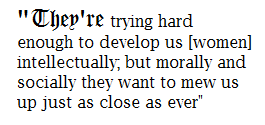
It really is very disturbing how little progress we've made in the face of feminism when you read a text like this that was produced over 100 years ago (published in 1895). The quotation above reflects a number of issues women are getting increasingly concerned about, in that they are having to now be recognised in an academic manner, but often have their behaviour proscribed to them in a moral and social sense. One only has to think about recent anti-rape campaigns, which focus on women changing their behaviour rather than changing the behaviour of potential rapists, to see that we still have a long way to go.

Herminia, son of a prestigious religious father, has rather radical ideas about her future. Rather than marry for love, money, or social status, she wants to join a man of an intellectual equal with her in a perfect union which is not bound by the law. When she manages to do so, and convinces him that this relationship is the way forward, they conceive a child, which they hope will be the advent of a new type of woman and class, in which marriage is disdained and women are man's equal. However, when fever strikes and her man dies, Herminia realises that there were quite a number of flaws to her plan ....


Although it starts off rather optimistic about Herminia's ideals, this text soon becomes tragic and very dark. Herminia was way ahead of her time, and her ideals simply cannot cohere with the world she lives in. With the death of her partner comes financial independence, and as a heavily pregnant woman there is little she can do. A life of poverty is begun, in which she is treated as a tainted woman. Moreover, she casts a dark shadow onto the future of her daughter with the dubious state of the relationship she was conceived in.

Have you read it? What did you think?
Steph x 


Thursday, 12 March 2015

Review of 'The Country Wife'

(image taken from google)

This 17th Century play goes hand in hand with The Man of Mode, which I reviewed here the other week. Again, this play forms a part of the Restoration drama canon, and as such has many of the common features of it. Very bawdy (to say the least), this play questions relationships and hierarchies between men and women. 


Horner (aptly named) creates a rumour at the beginning of the play that through some kind of venereal disease he has become impotent. This allows him to get away with far more licentious behaviour with men's wives than would otherwise be allowed. Alongside this plot, the audience follow the lives of many other characters. There is the not-so-witty Mr Sparkish, due to marry Alithea; Pinchwife, whose decision to shut his wife up from the contagion of London morals doesn't quite go to plan, and more.


As with The Man of Mode, many questions about gender roles and sexuality are raised in this play. The most potent of these (get the pun?) is the idea that as long as a man is impotent one's wife is safe with him. This largely dwells from the lack of contraception during this period - a man needed to make sure his heir was in fact his, so his wife had to remain untainted by any other man with the potential to produce offspring. I found it incredibly interesting that this was the key reason for keeping a woman faithful, rather than the spread of venereal disease or the idea of husbandly possessiveness (as is very prevalent in later literature). 


Have you read it? What did you think?

Steph x


Saturday, 28 February 2015

Review of "Out of Work"


You've probably noticed by now that a lot of the books I post about are, to put it lightly, a bit 'obscure'. However, I don't think this makes them any less valuable. As part of my course at university I get the opportunity to read a great number of texts that I otherwise would simply never come across, and although yes, I find some of them terribly dreary, a lot of them are incredibly eye opening. Take this book for example - written by John Law (Margaret Harkness) and published in 1888, it reads like a more easily understandable and shorter Dickens. As a lover of Dickens, I found this fabulous, especially as Law, unlike Dickens, manages to paint semi-realistic female characters! Also, it's full of thought-provoking quotations like the one above, which are alarming in that stereotypes along these lines are things that many girls and women of our generation have heard said to them in some way or another.

Polly Elwin lives alone with her mother and is engaged to be married to Jos, a young carpenter who has moved from the country to secure work. However, this proves harder than he had originally realised, and soon his decreasing funds loses him the respect of Polly's mother and he is no longer allowed to live in the house. Becoming more and more penniless, Jos comes across many issues in 19th C London, amongst them the possibility of a richer suitor seeking out his Polly ...


This book examines the poverty in London in the late 19th Century, alongside the riots it induced. Told from the perspective of an innocent man who is simply unlucky, the reader really gets to feel how inescapably consuming the problem of unemployment in England during this time was, and how helpless so many men felt. There was a great emphasis on the idea that a man had to earn a certain amount to be "worthy" of marriage, and this is one of the few texts one could regard as feminist from this time which i read that examines how destructive the ideals surrounding marriage at this time could be to men as well as women. Indeed, even the riots and the poverty of London is not only shown through Jos, but the women forced to sell their newborns for a matter of pence to keep the rest of the family alive, and so on.

Have you read it? What do you think of 19th century books about marriage?

Steph

Tuesday, 3 February 2015

Review of "Cometh Up as a Flower"

Utter madness isn't it *heavy sarcasm*, but for a book published in 1872, this quotation is pretty wild. I've read a lot of 19th century novels over the past few years, and quite a number of the heroines are somewhat lacking in a number of things: independence, a brain, passion and their own opinions to name but a few. Nell in Rhoda Broughton's Cometh Up as a Flower, however is something else - she actually defies feminine stereotypes and scorns the company of other women.

Nell lives alone with her father as her mother died when she was young. Despite their family name being one of high rapport, the Lestranges have gone way down the social ladder in recent years, to an extent that bills are unpaid and Nell's father's health is rapidly declining under economic stress. Nell meets a poor man called McGregor: handsome and flirtatious, he conducts an illicit relationship with her, which is kept a secret from her father. But, when her elder sister Dorothea returns to the family home, things begin to go a bit awry. Is love really worth more than money?

Although this book was written over a century ago, its language is not difficult or burdensome (makes a change for a 19th century novel, right?!). Nell's character is incredibly complex - she has a whole number of ideas concerning the social status of women in England, and has a number of factors which govern her every thought. Her sister Dorothea similarly offers a unique and often perplexing character: driven largely by money, she corrupts everything that is good in the novel and comes across as a true villain. This text really explores what your priorities ought to be when deciding who to marry. It also exposes some harrowing truths about the 'choice' even seemingly independent girls like Nell have concerning marriage. All in all, if you're interested in a look at how advanced first wave feminism could be in literature, this is a great text to go to!

Have you read it? What did you think?

Steph


Friday, 16 January 2015

Review of "Their Eyes Were Watching God"

Currently it feels like I'm drowning in a sea of paper (and believe me, my room looks like it!) as essay season is peaking, but will be drawing to a close in the next couple of weeks, so I'll definitely be posting a lot more frequently then. This quote was one of a whole plethora that I could have chosen from for their piercing realism, but I feel as though this has a lot to say about how people act in our modern world. Zora Neale Hurston's Their Eyes Were Watching God really made me think about how people act towards one another, and how we all need to come a long way before equality on any level is achieved.

Janie, a young girl with a chequered family history, is brought up by her grandmother. Encouraged to marry a man soon, so that her future does not become the same as her mother's past, Janie marries a man she does not love. However, Jody is just around the corner, tempting her with the thought of freedom, and the ability to escape to a new town run by coloured folk. Can she bear the thought of staying trapped by her husband's expectations of a mundane life for the pair of them? You had better read it to find out ...


This text dealt with a lot of issues that are still relevant today, despite being published back in 1937. Stop reading here if you don't want any spoilers. I think perhaps the most interesting part of the novel, and point that Hurston appears to wish to convey is that capitalism and racism are bound up within one another. When Janie and Jody move to the new town there is no mayor, so Jody becomes appointed as one. After this, he begins to increasingly place distance between him & Janie and the rest of the people in the town, looking down upon them as inferior beings. It is when this has occurred that racial issues are reinscribed to the town whilst everyone is a member of the same, or a similar race, Janie suddenly resembles the Queen of England, and Jody gains the air of a white man. Here the reader really gets a feel of how race and capitalism are linked: Jody's need to gain more possessions and improve labour output for the town requires him to treat the other town members as though he is superior to them, which makes them see him as a racially 'othered' figure.

Have you read it? What did you think?
Stephanie


Thursday, 17 July 2014

A Review of Lady Chatterley's Lover

https://blogger.googleusercontent.com/img/b/R29vZ2xl/AVvXsEjzLPGlASTz6tXtSw0kgR8dH-dmAb2XWXsiRPca3GDaN3WbRzq4TkaNrywtysycFCvrnZeIIaDMX3gAHyaJX7Q3JuejWMbvp1spIfjBguzX4UUDskOS0R7NbmoqI51NSC5mcw9X4YluTZKB/s1600/timthumb.jpg

D.H. Lawrence's Lady Chatterley's Lover is not only an important book in terms of its literary merit, but also its socio-historic impact upon England's publishing world. Although the novel was written in the 1920s, an uncensored version was not published here until 1960. Even then it caused a great deal of scandal: Penguin, the publishing house for the text, was forced to undergo an obscenity trial due to the explicit erotic language and themes the book contained. they fought for the literary merit of the book and the case was concluded with the verdict "not guilty". This makes Lady Chatterley's Lover a key implement in British authors' attempts to discuss erotic concepts in modern texts. 
The story commences with the tale of a sexually licentious girl who marries Sir Clifford briefly before World War I. He returns from the war paralyzed from the waist down. This allows Lawrence to broach the the uncomfortable and forbidden question at the back of everyone's minds: "does it work?". Unfortunately for Sir Clifford, the answer is no. 
Connie, or Lady Chatterley, becomes depressed as a result of their sexless, joyless marriage and begins to seek a lover to satisfy her maternal cravings for a child. This plot is ensconced in a Hardy-esque condemnation of the industrialization of England, as well as a self-conscious examination of class differences.
Despite hearing mixed reviews for the book, I don't regret picking it up (or rather downloading it to my kindle) at all. The book is a pastiche of genres, which I believe is a reason why it doesn't sit well with many readers. It has a great focus on man's connection with nature, which is emblematic of Romantic writing, whilst displaying the futility of human life, terse vocabulary, and lack of sentimentality of modern writing. 
The first portion of the novel seems rather dry and hard to digest. Yet, this appears to merely be a stylistic mirroring of Connie's sexually barren state: once she secures a lover the writing becomes more poetic and much more enjoyable. Though Connie is hardly a likeable figure, doesn't modern fiction often strive to teach us that people cannot be labelled as being good or bad, but rather are more complicated?
So if you want an easy to read, yet important piece of fiction to add to your "To Read" list this summer, pick up Lady Chatterley's Lover​ and give it a shot!
Love, Stephanie 

Tuesday, 1 April 2014

Is the greatest downfall of Shakespeare’s male tragic figures the fact that they underestimate the power of women?

The “heroes” of Shakespeare’s tragedies are often said to have a “fatal flaw” which leads them to their ruin. This fatal flaw could be hubris, jealousy, greed, or a variety of other emotions or drives. However, in many of Shakespeare’s tragedies the protagonist’s ruin is inextricably linked with the impact women in the play have upon his life. This appears to be true of Othello, Macbeth, King Lear and Antony and Cleopatra. All of the eponymous men of these tragedies are thwarted because they neither see the plots women are constructing nor do they appear to believe them capable of such a thing.
            Firstly, in Othello both Othello himself and Iago are doomed because they underestimate the power of the women in the play. Othello underestimates the power of Desdemona’s chastity. This leads him to believe Iago’s empty “evidence” for her infidelity and thus kill his newly-wed bride. In a sense Desdemona is powerless because she cannot control the manipulative lies spun by Iago, but the fact that Othello is driven to murder because of her sexual power shows that she has a great deal of this type of power simply because she is a woman. Moreover, the power women have to undermine the power of men in the play is highlighted in the fact that the volta of the play occurs when Emilia hands Iago the handkerchief; this piece of evidence is vital to the construction of his case for Desdemona and Cassio’s affair. Thus, without Emilia Iago may never have had the power to cause Othello’s downfall. Othello could never fathom the idea that Emilia may have stolen the handkerchief from Desdemona and given it to Iago because he is irrational and acts rashly rather than considering other possible ways in which Iago may have ended up with the handkerchief. Iago never acknowledges the help that Emilia gave him and appears to believe that his plot functions purely because of his own brilliant cunning. However, when Emilia exposes Iago to Othello at the end of the play as having constructed the plot which lead to Desdemona’s death Iago appears to realise that he has underestimated her. He underestimated the love that Emilia had for Desdemona, and for this he is ruined.
                        Similarly, the work of Macbeth in his eponymous play is driven forwards by his wife Lady Macbeth. Macbeth never truly appears to recognise to what extent he is controlled by his wife; this underestimation of her power causes his downfall. The murders of his intimate friend Banquo and the King he ought to respect are orchestrated by her. As soon as she latches on to the hope of him gaining power she becomes obsessed with it and drives him to seek more power. For this reason I believe that ambition is Lady Macbeth’s fatal flaw, not Macbeth’s. From the point at which she can see a powerful future, Macbeth becomes somewhat of a puppet for her bidding. Likewise, Antony in Antony and Cleopatra becomes a powerless man when he falls in love with the ambitious Cleopatra. Unlike Lady Macbeth, Cleopatra does not encourage Antony to do anything; he merely does what he thinks she would like him to do because he is so utterly besotted with her. To see a martial man so weakened in this way makes him a figure of ridicule; even his suicide is carried out for such a trivial reason that it is almost laughable. His death is directly caused by the hold that Cleopatra has over him, which even she underestimates. He never appears to understand that she is manipulating him, which allows him to underestimate the power she has over him and thus for her to cause his ruin.

            Lear on the other hand is not ruined by a lover but by his daughters. He does not believe that there could be untruths behind Regan and Goneril’s professions of love for him and thus hands over all of his lands to them. This makes him a powerless figure from very early on in the play as, without his lands, he has lost all of his authority as King. Moreover, he underestimates the fact that Cordelia could be wise and thus disinherits the only daughter who truly loved him. The further plotting of the two landed sisters results in both Lear and Cordelia being imprisoned which is closely followed by their deaths. Finally, by underestimating the power of all three of his daughters Lear not only causes his own ruin, but also that of the country.

Wednesday, 19 February 2014

The relationship between women and male power in Shakespeare’s Othello, Antony and Cleopatra and The Taming of the Shrew

Shakespeare’s plays, written during or shortly after Queen Elizabeth’s reign arguable present women in a relatively positive light. Although they do fall into the three stereotypical types of woman (the mother, the virgin and the whore), they use these roles to their advantage in order to subvert the whims and wills of men. At a time in which women were commonly understood to be subservient to men – although there was a female monarch at this time many people were upset at her lack of a husband to guide her – Shakespeare offers up outspoken, strong-headed, powerful women in the three aforementioned plays.
Firstly, in Othello a contrast is set up between the seemingly shy, subservient Desdemona and her loud, boisterous counterpart Emilia. Desdemona is a rather passive creature throughout the play; often she is only spoken about without being given the chance to air her opinions on things herself. Moreover, she is physically and verbally abused without being able to give a reasonable response to this because of her lack of understanding regarding the irrational (and foolish) actions of her husband. However, even this passive character is introduced to the audience as one who has denied the wishes of her father in staying at home and instead pursued her love affair with a “Moor”. This defiance would have been viewed as being very serious, as, indeed, it is by Brabantio who takes the issue to the Duke. In this way Shakespeare allows his most traditionally “feminine” character to subvert masculine demands for power. Furthermore, Emilia is used to highlight far more explicitly the power women have over men as she not only is responsible for Iago’s plan working so swiftly and smoothly by handing him Othello’s handkerchief, but also reveals his treachery to Othello at the end and thus causes his downfall. It has been argued by critics that Iago’s sole downfall in this play is the fact that he underestimates Emilia’s love for Desdemona: this is what ruins him. Thus she is the real puppet-master at the end of the play which reveals man’s subservience to the power of women.
Secondly, in Antony and Cleopatra the rivalry between Antony and Caesar would be the main plot strand of the play if Cleopatra was not quite so powerful. Antony’s extreme attraction to her, which even leads him to turn his ships around during a naval battle to follow her, makes the whole war almost laughable because it exposes just how controlled men are by their lovers: he is putty in Cleopatra’s hands. Her use of messengers to endlessly find out exactly what Antony is doing at any given time again shows just how much she is controlling him; he cannot do anything without being watched by her. Moreover, she manipulates the progress of the plot in the play: she ensured that Antony was not with his wife to look after his part of the Empire, she made the ships turn around, she directly caused Antony’s suicide, she even dictates Caesar’s actions once Antony is dead and finally she decides when and how she will die. Her aversion of Caesar’s plots highlight the fact that even arguably the most powerful man in the world cannot control a woman: she can always do this herself, even if it means going to extremes.

Finally, in The Taming of the Shrew the main body of the play is a play within the play. It is easy to forget that the play itself is about Christopher Sly and those who are playing a trick on him, it is not about making Katherine more “womanly”. The play in which Katherine and Petruchio play a part is constructed from male fantasy. Shakespeare is merely showing his audience what men believe should happen to outspoken women, not suggesting that all women should be subdued in this manner. The only woman in the play is the hostess of the inn who disappears after line ten having subjected Sly to her power by throwing him out of the public house as though he were an animal. Indeed, Kate arguably never becomes “tamed” as she is given the longest speech in the play at the very end of the play within the play; excessive talking is one of the prerequisites for being classed as a “shrew”. Shakespeare highlights the fact that men believe they have power over women by controlling their marriages as Baptista suggests the marriage between Kate and Petruchio and pursues it until it is done. Petruchio also insists on the marriage occurring without giving any thought to Katherine’s negating his marriage proposal. However, the main reason for the marriage going ahead is that there are other people manipulating the progression of the plot in order that Bianca can be married off; Kate is the only person who can give them that power by being married off herself. in this way Kate directs the whole course of the play and therefore can be seen as the most powerful individual in it. 

Wednesday, 11 December 2013

A Comment Upon Love Triangles in Victorian Literature

Most of us are accustomed to love triangles as being a standard part of the majority of modern romantic comedy films, however this has been around for considerably longer than originally thought. Although it has been used by writers (or poets as they were known in Ancient times) since Ancient Greek literature the development of feminist perspectives in the Victorian era allows it to take on a new meaning.
            There are clearly two ways Victorian writers create love triangles: two men vying for a woman’s affections, or two women vying for a man’s. Which one they choose depends on the particular representation of the two genders that they are trying to evince in their writing. Emily Bronte explores gender through this type of love rivalry in Wuthering Heights in a particularly interesting way as she utilises both of the above forms and does so in a way that makes the reader sympathetic towards women as well as making them strong characters. Cathy Earnshaw is sought after by two men (Heathcliff and Edgar Linton) and is free to make her own decision regarding her future husband. This commences well until Cathy is forced by Heathcliff to realise that in marrying Linton she has defied her true nature which is bound to him. The mental turmoil she then succumbs to eventually leads to her death as she cannot lie with this inner tension. Thus, although Bronte creates Cathy as a seemingly independent, strong woman her death is induced by the power this love triangle has over her. Indeed, this book has another triangle in which the wrong choice is made, however this time not unwittingly. This is between Heathcliff, Cathy and Isabella Linton. Heathcliff’s intentional abuse of Isabella’s feelings in marrying her to secure property and because he cannot marry Cathy (thus making her the second choice) serves as an example of the cruelty of men in the art of love in the Victorian era.
            Another writer who particularly likes the use of love triangles is Thomas Hardy. Both Tess of the D’Ubervilles and Far From the Madding Crowd explore the nature of men through their differing attitudes towards love. Hardy uses this arrangement to comment socially upon the transition between traditional ways and the coming of the “Golden Age”. In Tess the contrast between the new age and the old is highlighted with the characters of Angel and Alec D’Uberville. Although there is this foundational contrast between the two they are both morally corrupt, which highlights the fact that neither traditional ideals nor modern ones are morally and socially appropriate; perhaps an amalgamation of the two is more ideal. Thus Hardy utilises the love triangle between these two men and Tess to not only explore the social context of womanhood in the late 1800s but also that of masculinity in a sexual context.
            Furthermore, Austen uses this form of relationship struggle to highlight the way in which a woman ought to behave in her novel Mansfield Park. Fanny Price and Mary Crawford vie for Edmund Bertram’s attention, but in the end Fanny secures the position of being his wife because of her inner purity and piety. Austen here socially condemns the modern way of life with drinking, gambling and doing perverse things in large towns, especially London. Mary’s character ensconces immorality at a simplistic life with her utter refutation of religion as well as leading a nice, rural life. Thus, this love triangle exposes the idea that cohering to modern ideals will not secure you a lover; you must stay true to being good.

To conclude, at the centre of these and many other Victorian love triangles I have not mentioned is not love. Instead these authors are exposing that to secure what one strives for in life (that is, a life partner in those days) one must have a keen moral sensibility and use it to do what is socially, as well as religiously, correct.