Showing posts with label chick lit. Show all posts

Sunday, 28 April 2019

Review of 'On the Other Side' by Carrie Hope Fletcher

Review of 'On the Other Side' by Carrie Hope Fletcher

I FINALLY feel like I'm making some headway into getting all my reviews up (though I'm fairly sure I said that back in January and I'm a solid three months behind again). However, this does mean I've got some excellent books to share with you on the way that made for great reads, and I'm so excited to write about them all!

On the Other Side is a story all about love and loss and secrets. 82-year-old Evie dies peacefully in her sleep, but can't quite pass into heaven. Instead she's trapped in a (pretty pleasant) purgatory that exists for her in her old apartment building. Evie's soul is too heavy to pass over into the afterlife; she's too weighed down with the secrets of her past.

Evie's transported back to when she was 27, and deep down she knows exactly what's keeping her at bay, though it's hard to delve into the wounds of her past. Born to a wealthy family, she was forced to leave her one true love, and marry a man with a good title, but in order to leave her past behind her, Evie might have to delve into exactly that, and find her way back to her true self.


The story behind this is like nothing I've heard of, or read before. It really makes me admire Carrie even more because wow it takes a big creative streak to come up with this story. I'm sure there are similar books out there that I've never heard of, but this one really came together well.

The book discusses a whole lot of important topics, including love, loss, friendship and family ties. But one of my favourite things is that the book contained multiple key characters from the LGBTQA community, and that they didn't both have the same sexuality. One character is a gay man who's struggling to come to terms with his feelings in a world and family that has never even considered the possibility of him feeling this way. The other is a pansexual woman who explains being pan in a way that everybody can understand, and I'm so grateful for Carrie putting these in. It's so important that we read diverse books and writers include diverse characters.

There's a whole lot of magical realism in here, so if that's not your thing then you might want to steer clear. But if it is, then this is such a comforting (though tear-jerking) quick read to go for.

Follow me on Bloglovin | Twitter | Instagram | Youtube

Sunday, 27 January 2019

Review of 'The One We Fell in Love With' by Paige Toon

Review of 'The One We Fell in Love With' by Paige Toon

I've said it before, but I'll say it again now, chick lit is my guilty pleasure. It was something that I gave up reading entirely when I was studying English at uni because wow the judgement would have been extreme, but as soon as I finished my degree it's all I read for months.

Now it's something that I love to dip in and out of. There's something so comforting about the format of it, where you know things will (99% of the time) end up right in the end, and sometimes I really need that rose-tinted look into the world. 

The One we fell in love with is Angus, the classic boy-next-door who moves in to the house next to three identical 17-year-old triplets. Who are stereotypically beautiful: slim, blonde haired, and green-eyed. What a day for him! 

However, although the triplets may look the same, they're all so very different, and problems really start for their hormone-filled teen years when all three of them fall in love with him. The book starts when Phoebe (the most conventionally attractive of the three, personality-wise) is about to get married to Angus. She saw him first, and that was that. 

The book explores how loving the same person changes the relationships between the sisters, and what happens when the adult sisters find each others' diaries ... 

I really didn't like the whole premise of the book if I'm honest, and I think it feels fairly clear to the reader that the author is churning out a book every year. The idea that three sisters with very different personalities could all fall in love with the same guy just completely turned me off from the book because 1.) would that really ever happen? and 2.) you wouldn't just allow the first one he met to have 'dibs' on him. The whole book is based around this idea that Angus met Phoebe first and ended up with her (when they weren't the best match) and not one of the other two because of that, and I just? Is that really how things happen? Did no one step in to tell him he had the wrong girl?

I will say that the writing was good and the novel got better as it went along, and there were some parts I genuinely enjoyed. It was also a nice quick read, so it's not something I regret reading, and I'll be trying another one of the author's books to see if this just had a bit of a strange premise, as it's what really put me off!

Follow me on Bloglovin | Twitter | Instagram | Youtube

Sunday, 1 July 2018

Review of 'Living in the Past' by Jane Lovering*

Review of 'Living in the Past' by Jane Lovering*

Magical realism is something I've always struggled with in books. It might be because the first time I learnt about it I was reading an Ian McEwan novel (and I really don't get on with those), or it might be because I can't stand the clash between fantasy and reality. It's probably a bit of both.

The main premise of this book is that strange things start happening when Grace, our protagonist, goes to an archaeological camp site. Somehow she's seen people that no one else can spy, and everything feels a little bit off. Thankfully, although at first I found it hard to merge the realistic sodden camp life with these passages where Grace loses herself, the book was genuinely very well written and it meant that you could easily flit from one time to another.

Grace became a widow two years before the narrative commences, and she's still impacted by her loss every single day. Desperate to get Grace to start to reconnect with herself, her best friend takes her away to a very muddy camp site to take part in a dig. Grace is beyond reluctant at first, especially as staying in a tent in the middle of nowhere isn't exactly her idea of fun, but she eventually caves in.

Things get a little more heated when Grace starts to spend time with the head of the dig, Duncan. Moody, reclusive and a little bit mysterious, Duncan finds he can open up to Grace, and together they discover exactly what was going on at the site back when humans first lived on it.

I really did enjoy this once I'd got into it. I found it started off a little slow in the first few chapters, but it was definitely worth sticking with! The author created wholly believable characters, and explored the impact of grief well without making Grace shrug it off when she found a new spark (this happens WAY too often). I loved reading about a male character with flaws and anxiety. This book was refreshing, easy to read and ended at just the right point.

Follow me on Bloglovin | Twitter | Instagram | Youtube

Saturday, 11 November 2017

Review of 'Too Damn Nice'* by Kathryn Freeman

Review of 'Too Damn Nice' by Kathryn Freeman

I always find that as Winter draws near I'm wanting to read more and more chick lit books. There's just something so cosy and joyful about them, you know? This is my favourite that I've read in a few months. I like my chick lit to take on some darker themes, and challenge some serious issues in society. I feel as though it's important to tackle taboo areas, and make sure that chick lit is a little educational, as well as comforting. 

Too Damn Nice really seems to have hit the nail on the head in terms of the context of the time I read it. It's all about a woman in the entertainment industry who's molested by a man she trusts, and she's outed by the media as being a slut. At the moment, with the 'MeToo' campaign, and the discovery that Harvey Weinstein is a sexual predator, more and more women in the industry are coming forward to talk about the harassment they've faced on their way up the ladder.

In the book, Lizzy Donavue makes news across America as her (ex)partner releases a video of her having a threesome with him and another man. As she's about to become the face of a perfume called 'Innocence', she's terrified that her career is in tatters. What makes it worse? She doesn't even remember the incident taking place. Lizzy's ex threatened her with the video, but she never believed that he would release it if she didn't pay him ... sadly she was wrong.

After locking herself away in her apartment, her brother's best friend Nick Templeton is the only person who steps in to help her. The worst thing about this? He's a painful reminder of the fact that she's lost her parents, and her brother is in a coma; something she still blames herself for. Bookish and shy, Nick's the opposite of model Lizzie, but he's always had a soft spot for her. 

Whisking her away from a toxic environment and back to England, Nick's intent on saving Lizzie. But there are some painful memories for both of them back in the UK. Can they make something work between them in the face of their history?

Follow me on Bloglovin | Twitter | Instagram | Youtube 

Wednesday, 16 August 2017

Review of 'Eat Pray Love' by Elizabeth Gilbert

Review of 'Eat Pray Love' by Elizabeth Gilbert

I don't use the word 'life changing' often, but this novel has totally made me put my life into a new perspective. I've heard Eat Pray Love hailed as an incredible read for years, but hadn't delved into it. It's now something that I want every woman ever to read. I want to lend it to all my friends and family so that they can embark on a journey to learning more about themselves and about life in general as they travel with Liz.

Eat Pray Love is a semi-autobiographical novel, based on the author's own travels to Italy, India and Indonesia. Liz, aka Elizabeth Gilbert, ended her marriage in a bitter divorce. After a passionate, if a little fiery and messy affair with a man called David and subsequent break-up, she found herself in a pit of despair. 

Depression had come knocking on her door, and she was tired of living the same life, just without a man. So, she started doing things for her. First she travelled to Italy, where she practised speaking a language she loves, and put back on the weight that she lost from stress through the divorce. Then she went to India. There she stayed in an ashram, spent time cleaning temple floors, meditating, and getting close to her spiritual core. Finally, she ended up in Indonesia to help an ancient medicine man learn English, and find a balance in her life that would keep her content.

The section dedicated to Liz's time in India was definitely my favourite, and resonated with me SO MUCH. Her time in the ashram helped her learn more about herself, about how to let go of the past and to accept change. It's something that I'd like to do too. 

Have you read it? What did you think?

Friday, 13 January 2017

Review of 'A Walk to Remember' by Nicholas Sparks

Review of 'A Walk to Remember' by Nicholas Sparks

I've never really resonated properly with a review of a book on its cover. They're usually filled with 'Amazing', 'Unputdownable', or a whole variety of buzzwords. The one on the back of A Walk to Remember, however summarises exactly how I feel about this novel: 'every now and then you stumble across an extraordinary book that at first appears like countless others, but then you read it and are amazed at the treasure within'. This review is by the New York Sunday Post, in case you were wondering.

A Walk to Remember is something that I've been meaning to read for years. I bought it before I went to uni, so it's been sitting on my shelves for at least five years now. The film that is based on this book is one of my favourite films of all times, and it's why I picked up the novel in the first place. I absolutely whizzed through it, lapping up all the extra little details that the book had to offer. The one thing I would say is that if you've seen the film and want to read the book, then the Landon you know is not quite like the original Landon. He was a little meaner, a little more selfish, and a whole lot less likeable.

So, A Walk to Remember is all about a girl called Jamie. Her father, a preacher, is her only family, as her mother passed away a few years earlier. Being brought up in such a religious family has greatly impacted Jamie's outlook on life: she attempts to see the best in people, carries a bible around with her everywhere, and does an immense amount of work for the local orphanage. 

Naturally, this introvert, who's a little saintly and carries around a bible with her isn't the most popular girl at school. Thankfully for Jamie, she either doesn't notice the sarcasm of the bullies or at least pretends to. One of those bullies, Landon, is forced to work with Jamie for a drama class assignment. They're the leads in a play and Landon, a 'popular guy', simply can't be seen with Jamie. Eventually he comes to realise that this shy exterior of a girl has a wealth of goodness and character beneath it. With Landon we being to see that everyone is worth getting to know.

This novel is beyond heartbreaking, but I've decided not to spoiler any of that part for you. If you've read the novel or seen the film then you'll know what I mean. Reading the end part of this on a bus was a total mistake for me, and I ended up sobbing and getting some interesting looks. Just remember that this is the guy that wrote The Notebook

Have you read it? What did you think?


Sunday, 31 May 2015

Review of "Us"


It took me about four years after "One Day" was published to actually get around to reading it despite the hype ... and that might have been because I wanted to watch the film (pretty much a crime, I know!). I've been similarly slow with this book by David Nicholls, but not quite to the same extent! Despite the raving reviews that I've seen scattered over the interwebs, I was actually a little disappointed. Reading is a chance to escape things, and this book pretty much felt like I was being endlessly slapped around the face with a chipping away of hope over and over again. Now, I can't speak for anyone else, but I usually want to like my protagonists, but let's face it, Douglas is a bit of a dick. I have to say though, this kind of worked in the book's favour - I think we need to be reminded sometimes that we all have a bit of an asshole inside of us that always seems to come out at the worst of times. We all make mistakes, and unlike what the majority of novels suggest, a multitude of "sorrys" and a romantic gesture can't always fix something that's broken.


Douglas Petersen is woken in the middle of the night by his wife of almost twenty years, Connie, stating that she wants a divorce. Not only is Douglas unaware of anything being wrong with their relationship (whoops), the timing is unfortunate as they're about to take their 17-year-old son Albie on a Grand Tour of Europe - something which Connie doesn't want to put off despite their marital dilemma. Douglas is left to consider exactly what he's done wrong, or rather not done right, in the twenty years they've been together, and as they move across Europe he realises that he's perhaps not been the most perfect husband and father. Despite this slow epiphany (oxymoron much, sorry!), he aggressively publicly denounces Albie as an embarrasment, causing Albie to run away across Europe alone. Now Douglas is left with a slightly larger conundrum: how does he get both his wife and son back?!

Author: David Nicholls
Publisher: Hodder & Stoughton
Published: 2014
Rating:


Saturday, 23 May 2015

Review of "The Jade Lioness"*


I feel so privileged to be able to read Christina Courtenay's newest release! The Jade Lioness is the third installment to her Japanese trilogy, the Kumashiro series, and despite not having read the first two, I was able to pick this up and get through it with ease. Plus, now I want to go back and read the others! I love love love reading books set in exotic locations - as someone who hasn't travelled much but would like to, the beautiful descriptions of places I've never been to really inspires the nomad in me. 

The quotation I chose for this review felt so potent for me because a book set in the 1600s should not see women faced with some of the same problems as those of our current day. Women are still sold into marriages, or sexual relationships all over the world, and it is something that we really ought to challenge, especially where it is accepted. 


During the throes of civil war in England, Temperance has joined her cousin Nico, an important Dutch trader, and his half Japanese wife Midori, on an incredible trip to Japan. There's only one problem: foreigners are hated, and the traders are confined to a tiny island called Dejima. Foreign women aren't even allowed there, and Midori must pose as a concubine to Nico, whilst Temperance adorns herself in male clothing. 

However, Temperance is soon forced into an impossible situation. Haag, one of Nico's traders, realises she is a woman, and attempts to coerce her hand in marriage. With only two weeks to try and work her way out of this dilemma, the claustrophobia of the island becomes too much for Temperance, and she steals a boat to get to a nearby much larger island. What she expects is to get away from her troubles - she doesn't plan on meeting Kazuo, a rugged outcast seeking to restore his father's name.

Returning to the island a week later, Temperance expects to meet him again, though her Puritan conscience wants her to remain away from the temptation he poses. However, she meets a group of outcasts who kidnap her and drag her through the island until she is sold is a concubine. From there, Temperance must make her own fate. 

Have you read it? What did you think?

Steph x

Thursday, 23 April 2015

Review of "The Wedding Cake Tree"*

(image taken from Goodreads)


A couple of days ago I came across the phrase "book hangover" on Instagram and that is the best way I've ever heard the idea being described. You know when you finish a book and can't pick up a new one for a day or two because you're still contemplating the world of the old one? Well that's what I had with this. There were so many important messages in it about love and identity, but I think the most important one was that expressed in the quotation I picked out above.


Grace Buchanan is hit hard by her mother's seemingly sudden death, but she isn't exactly prepared for the conditions of her will either. Rosamund, Grace's late mother, has insisted she take ten days off of work to go on a mysterious trip with hunky military man Alasdair. Despite Grace's extreme reluctance to go, her mother's desire to have her ashes spread in the places she will travel to means that she can't exactly say no. However, was this Rosamund's only intention for the journey? And how will Grace deal with having to put her life in the hands of a man she's never met before?


I pretty much figured nothing could ever make me want to travel to Scotland as much as this did. As someone who lives in the south of England, concepts about the environment of Scotland are usually filled with "HOW much snow?!", so it's never seemed too appealing. However, the descriptions of the beautiful landscape here make me want to pick up a camera and go travelling up there myself. There was so much chemistry between Alasdair and Grace that I was practically begging for them to get together the entire time. I don't think I've ever rooted for a couple as much as this since Dexter and Lumen!

Have you read it? What did you think?

Steph x


Saturday, 11 April 2015

Review of "The Woman Who Did"

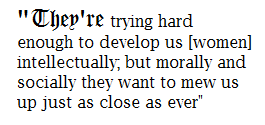
It really is very disturbing how little progress we've made in the face of feminism when you read a text like this that was produced over 100 years ago (published in 1895). The quotation above reflects a number of issues women are getting increasingly concerned about, in that they are having to now be recognised in an academic manner, but often have their behaviour proscribed to them in a moral and social sense. One only has to think about recent anti-rape campaigns, which focus on women changing their behaviour rather than changing the behaviour of potential rapists, to see that we still have a long way to go.

Herminia, son of a prestigious religious father, has rather radical ideas about her future. Rather than marry for love, money, or social status, she wants to join a man of an intellectual equal with her in a perfect union which is not bound by the law. When she manages to do so, and convinces him that this relationship is the way forward, they conceive a child, which they hope will be the advent of a new type of woman and class, in which marriage is disdained and women are man's equal. However, when fever strikes and her man dies, Herminia realises that there were quite a number of flaws to her plan ....


Although it starts off rather optimistic about Herminia's ideals, this text soon becomes tragic and very dark. Herminia was way ahead of her time, and her ideals simply cannot cohere with the world she lives in. With the death of her partner comes financial independence, and as a heavily pregnant woman there is little she can do. A life of poverty is begun, in which she is treated as a tainted woman. Moreover, she casts a dark shadow onto the future of her daughter with the dubious state of the relationship she was conceived in.

Have you read it? What did you think?
Steph x 


Sunday, 5 April 2015

Review of "The Two of Us"

(taken from Simon and Schuster)


Nowadays there's pretty much two camps of young couple, and they're separated by their reaction to a little positive sign on a certain test. There's the "eeeek we're having a baby" and the "oh god WHY? What are we gonna do now?!". So, what happens when nineteen days into a sexathon of a relationship your 40-ish year old girlfriend gets pregnant ... a bit of both?

Fisher and Ivy just want a simple relationship filled with lots of fun. Fisher's almost certain that Ivy's the one. That is, until she starts acting cold towards him. Thinking he's committed some kind of horrendous faux pas, Fisher wants to do anything he can to win her back. However, when she announces her pregnancy, will their budding relationship be able to last?

*SPOILER ALERT*
This one was a bit of a tear-jerker I have to say. As Ivy's pregnancy progresses, us readers are witness to all the highs and lows of the upcoming birth of Ivy and Fisher's twins, as well as their relationship in itself. However, when they lose one of the babies a couple of weeks before the due date, and have to say goodbye to one stillborn twin whilst learning to love the other we really get to see just how far human emotional pain and the ability to recover from it can be stretched.

If you like whirlwind romances, and are looking for something with a little more depth in, I would highly recommend The Two of Us.

Have you read it? What did you think?
Steph x


Tuesday, 31 March 2015

Review of 'The Soft Whisper of Dreams'*


This has definitely been my favourite book of 2015 so far. I am a big fan of Christina Courtenay, and all of her books which I've been lucky enough to read so far have been pretty fab (Monsoon Mists was one of my top reads of the summer, and you can check out the review for it here). Also, I don't think I've seen London so accurately described in one sentence before as it was in the above quotation.

Maddie's parents die suddenly, and now the only family she has left is her bitch of a sister. That is, until the will tells them that Maddie was adopted, and so, unless her sister displays some heart (highly unlikely) she's now inheritance-less. Needing to get away from the city and the shock of all that's happened, Maddie takes a break in the country at her best friend Kayla's. She expects peace, quiet and a chance to see Kayla's kids. What she doesn't expect is Kayla's hunk of a brother-in-law to be staying there, nor to recognise a resident from the nearby town. When things start to get scary, Maddie is forced to question everything she thought she knew.


This plot had so many strands coming into it that there was never really a dull moment in the book. Courtenay once again creates realistic, believable and over-all humanity-affirming love interests. There's no ridiculous sex scenes (hello one I read where a tampon was whipped out by a guy ... on the first time?!), and the characters all have a great deal of depth to them. Moreover, if you like a bit of a thriller, The Soft Whisper of Dreams has that for you too!

Have you read it? What did you think?

Steph x


Monday, 23 March 2015

Review of 'Marina in a Green Dress

(image taken from goodreads)


As a child, Walt Disney taught me that 'if you don't have anything nice to say, don't say nothing at all' (in the words of Thumper), so I'm going to keep this short and sweet. I picked up Marina in a Green Dress a couple of weeks ago as it was free to download onto my kindle and I wanted to go for something I hadn't really gone for before. Now I have to say I slightly regret it, and was pretty disappointed. The idea of a book based around a female protagonist who loves musicals sounds awesome, but in reality I don't think this one really worked out.


Jessica moves to London in the hope to get away from her restrictive Northern parents who believe that education and university ought not be everyone's top priority. She goes to see her favourite musical, 'Marina' on a regular basis, much to the chagrin of her boyfriend Steve. However, when a joke letter asking the lead actor of the play to meet her gets sent, Jessica's life changes irreversibly. It's up to you to decide whether it's in a good way, or this is taking her down a darker path ....

This just didn't hit the spot with me. I felt as though I could not in any way connect with the protagonist, which I find really spoils a book. Her thoughts and actions baffled me, and I more frequently felt as though i sided with the reason of other characters in the book.

Have you read it? Did you enjoy it more than I did?

Steph x


Tuesday, 10 February 2015

Review of "Never Too Late"* | Q + A with Christina Courtenay

I love love love this quote, and haven't found another description quite so accurate in a while! Christina Courtenay earnt a little soft spot in my heart when I read Monsoon Mists (review here), which was my favourite book of the summer. Never Too Late was kindly sent by Choc Lit to me and I was lucky enough to be given the opportunity to have a mini interview with Christina Courtenay herself! This novella is a really quick, easy read which you can finish in a couple of days, or is brilliant for a long coach/plane journey.

Maude and Luke, young lovers, seek to elope, but their plans are thwarted at the last moment. Set during a period in which Maude's father can control her life, their plans are discovered and she is locked up at the last moment, a fact that Luke remains unaware of. Forced to marry his older brother Edward, who is the inheritor of the family estate, Maude lives a miserable life until he dies and Luke must move in. Despite their rocky past, can their feelings overcome their fate?

Question and Answer with Christina Courtenay

1.) What time period is Never Too Late set in? And what were your inspirations for writing a novella set during this period? 
It is set during the Regency period, in about 1812-13. I didn’t have an exact year in mind but the hero has fought in the Peninsular War which lasted until 1814 and has had to sell his commission to come home and take over the running of his late uncle’s estate so it’s before the end of the war. My main inspiration was the incomparable Georgette Heyer – I have loved her books from the moment I first found one in my school library. She made the Regency period come alive and that’s what I tried to do too, although my story is a bit more provincial than most of hers.


2.) Having read Monsoon Mists, what are the benefits of mixing romance with crime//mystery?
I think having a mystery as well as a romance adds depth to a story and hopefully makes it more enjoyable for the reader. You don’t just have the “will they-won’t they” questions of the romance, but also “will they even survive to have a romance” added to the mix. I didn’t actually set out to have a crime/mystery in this particular story, it just sort of evolved that way once the idea of the stolen talisman entered my mind. I figured it was the sort of object that was bound to cause greed, corruption and envy.


3.) I've noticed that your sex scenes are quite realistic and tend to steer away from the "50 Shades of Grey" bandwagon that a lot of contemporary authors have jumped on. What do you think of this craze? 
Thank you, I’m glad you think they are realistic! I have to admit I haven’t yet read 50 Shades – I know, shock, horror! I just haven’t had the time – but apart from the sex it obviously has some very special characters to have attracted so many readers. Jumping on any bandwagon is never good though – publishing tends to move quite slowly so if I were to write a story like that now, it wouldn’t be published for at least a year, if not more, by which time that craze will almost certainly be over. It’s been great for those authors who already had similar stories ready, but now it’s too late. I think it’s better to write the kind of stories you want to write, as well as you possibly can, and hope it’s what your readers will like.


4.) Where do you seek inspiration from to create such diverse books?
I find inspiration from lots of different things and anything can spark a scene in my mind – a house, a person, an object. I can’t remember what made me write Never Too Late, but Monsoon Mists came about because the hero, Jamie, had seemed to be one of the bad guys in the previous book in the Kinross trilogy (Highland Storms), but in reality he wasn’t. So I wanted him to be allowed to tell his version of events. Some of my other stories have been inspired by for example a ghost in a house I used to stay in (I never saw it but the owners did), an extraordinary painting in the National Gallery and a replica of an old sailing ship.


5.) Who are your favourite male and female characters that you've created and why? 
I have a soft spot for Killian Kinross, Jamie’s father (and the hero of Trade Winds) because he’s
gorgeous, has a great sense of humour and is very mischievous – he’s the archetypal “bad boy” I suppose you could say and I love those! I like his wife Jessamijn too – she stands up her step-father who tries to bully her. But I also really like Nico Noordholt and Midori Kumashiro, the hero and heroine of The Gilded Fan. It’s difficult really because as an author you are usually totally into whichever hero/heroine you are working on at the moment. Right now I’m writing about a Cavalier with long dark hair and green eyes … 

Thank you!

Thank you very much for inviting me!

Any comments/questions are always very welcome :)
Steph

Tuesday, 20 January 2015

Review of Getting The Picture*

So, a little email from Dean Street Press brightened my day (let's face it, week), when they offered me the chance to review one of their new releases. I'm so thankful they did as Getting The Picture, which you can buy here, did not disappoint. Written entirely in letters, notes, emails and answering machine messages, this book is full of touching reminisces of a life that once was, or could have been. I personally love authors who toy a little with your feelings, getting you to turn this way and that in terms of who you trust - believe me (oh the irony), this book does test you a bit.


Martin Morris, a retired pornographer, moves into Pilgrim House and is delighted at the prospect of getting to know his ex-lover, Mo's, husband. Having always imagined that she would not leave her husband for him because this husband was a wonderful person full of positive characteristics, he is somewhat perturbed to meet the grumpy, obsessive George. The book centres around letters from Martin to the dearly missed Mo, but features communication from different residents to one another, the care workers and George's family. 


This is only going to be short, as I think over-analysing this book would take away from some of it's charm. At first reminding me of 'The Notebook' (one of my top favourite films), it really explores what it's like to grow old and feel unfulfilled in your love life. The manner of writing which the author develops here really allows for a multiplicity of perspectives to be displayed, whilst the true identity of the character is somewhat concealed - after all, if you're writing a letter to someone you are presenting them with a version of your life that you want them to see. All the little snippets of information the reader gets build up until all of them start to come together and you really start 'Getting the Picture'. I would highly recommend it to anyone with an interest in romance who's getting bored of the cliched boy meets girl, boy loses girl, boy gets girl back narrative.

What do you think of books that are written in non-conventional forms?
Stephanie

Wednesday, 13 August 2014

Trends in Chick Lit

Everybody has a guilty pleasure when it comes to reading. For some, it’s fantasy novels, comic strips, or even the likes of Fifty Shades of Grey. For me, it’s the generic chick lit novel: girl is lonely, girl meets unlikely match of a boy, girl and boy fall in love (surprise, surprise). The simple and near-identical structure of these novels appeals to my willingness to remain right in the centre of my literary comfort zone. However, recently it’s come to my attention that this style of book isn’t quite as superficial as it first appears to be.
A few years ago, a large proportion of this genre of literature was centred on female body image. Obesity was a hot topic in the UK and USA at this point as shocking statistics were being poured out over the media concerning the 61% of the population deemed to be within this category (statistics as of the NHS’ report concerning obesity in 2010). At this time, and for a couple of years preceding it, chick lit authors positioned this issue at the forefront of their novels. This encouraged people, especially young women, to love their bodies even if they are technically overweight. This body-beautiful campaign as such was taken up by many authors worldwide, including one of my personal favourites, Meg Cabot (Princess Diaries anyone?). Her range of adult novels includes the Heather Wells mystery series, which tracks the progress of a young woman who has been criticised because of her large size. The books explore the idea that being overweight does not make a person unattractive, or unsuccessful. Thus, they serve to work against the “fat shaming” that goes on in the media: critiques of celebrities gaining a few pounds and the endless advocation of (unhealthy) fad diets in seemingly every magazine with a female target market.
Recently however, as the issue of obesity has become a less pressing issue in the media, chick lit authors have turned their attention elsewhere. Recent figures in mental health statistics have becoming increasingly alarming, to the extent that 1 in every 4 people experiences some form of mental health issue every year; the most common being depression and anxiety disorders. Again, as the media has begun to focus on these issues, so have chick lit authors. The two novels which I have read so far this summer as part of this genre have adhered to this. Both feature mentally unstable female protagonists who have undergone some form of trauma in their lives and thus (unfortunately) need to be rescued by the loving, handsome boy-next-door as it were.
After a hectic period of second year English Lit exams and getting a new kindle for my birthday I really wanted to chill out with a simple chick-flick on holiday. As a student I obviously instantly started scrolling through the reams of (largely awful-looking) free books in this style on Amazon. Coming across "Twenty Eight-and-a-Half Wishes" I didn't expect much and the opening chapters held out to this expectation.
The book is set in a modern Southern style landscape. The protagonist is an anxious 24-year-old girl who finds it hard to feel appropriate emotions towards events. She lost her father at a young age and is controlled by a wicked mother. This Cinderella-esque storyline was waiting for a Prince Charming to arrive, but, akin to most other romantic novels of our era, Joe McAllister is a rugged, mysterious figure. This generic outset initially jars with the magic realism that Rose's visions imbibe the plot with. Her blunt reaction to (not giving any spoilers) certain tragic incidents in the novel heightens this; in my opinion making this protagonist and the book itself too unrealistic.
However, after the disappointment of these first few chapters the novel improves greatly. It develops into a mystery-romance novel rather than a mere romance one, which allows it to offer much more to the reader in terms of plot and interest. Moreover, Rose's visions no longer seem to jar with the main plot, but cohere with it and enhance it, allowing the reader as well as Rose to have a stronger grasp of the mystery at hand than most other characters in the text. Rose’s visions as well as her social anxiety arguably hint at deeper mental issues within her character. However, the fact that the visions save Rose’s life portrays an important message to the reader: mental illnesses do not have to destroy your life. This is something which Rose learns as she develops as a character.
Similarly, Natasha Preston’s first book in her (appropriately named) “Silence” series raises a great number of important issues surrounding the moving issue of childhood sexual abuse. Despite a pretty good (albeit clichéd) romantic back story to the plot, the traumatic effects of this type of abuse upon a teenage girl remained the key focus of the novel. Silence follows the story of 15-year-old Oakley who hasn’t uttered a single syllable since the age of 5. Her overwhelming love for her 17-year-old best friend/neighbour/all-round good guy Cole encourages her to consider the impact of her silence on others, including her family. Oakley, her loving parents and sex-obsessed older brother make up the Farrell family unit. But as the novel rapidly makes clear, Oakley’s silence isn’t the only aspect of the family’s problems which doesn’t immediately meet the eye …
Set in England, the social issues which this novel raises really struck home for me. Moreover, with the recent numerous allegations of child sexual abuse by famous men in the media business, the concerns this novel raises are at the heart of heated discussions in the UK: can we really trust our children with anyone? How does this kind of abuse affect the mental health of the victim as they reach puberty and beyond?
I believe that the most important aspect of this novel is the exploration of the ways in which sexual predators transform their victims in order to cover up their horrendous acts against human decency. Oakley has her voice physically and metaphorically removed in a hyperbolic symbolization of the fear in which these victims live.

Once you get past the slightly bad writing that characterises the initial chapters of both the books discussed above, they really do expose some harsh realities about the state of modern life. Women are statistically more likely to suffer from depression than men, which perhaps explains why these authors have chosen for their female protagonists to be portrayed as fragile, imperfect creatures. Perhaps they want to suggest that if you really get to know a person (as the reader does with the narrative voice) everyone is broken. However, there may be a greater issue at hand: are these modern chick lit authors falling into the fallacy of creating almost 19th century female protagonists who can’t survive without swooning into the arms of a life-giving, life-saving man?