Showing posts with label england. Show all posts

Sunday, 3 July 2016

Review of 'The Thirty-Nine Steps' by John Buchan


June marked the two year birthday of my one true love, aka MR Kindle. So, I decided to tie up some loose ends on it. When I first got my kindle I was a little eager beaver, wanting to download a tonne of the free classics you can get on a kindle because the concept of free books was totally new to me. This was one of them, and as you can (presumably) tell, it sat on my digital bookshelf until now. Whoops. 

Since graduating last year, I've been on an anti-classics rampage. No longer governed by my professors, I've been free to read whatever I want, whenever I want, and it's been glorious. However, recently I noticed that I felt as though there was something missing in my literary life: I'm done with being wayward, and want to get back to my roots of reading anything and everything, and delving into history through classics.

So, with a little spring in my step, I finally embarked upon reading The Thirty-Nine Steps ... and was met with a dark, almost Gothic novel. Did you ever read The Secret Seven or The Famous Five as a child? Well imagine them, but with a little more death and dark mystery, and you have The Thirty-Nine Steps. Even the title has an almost Blyton-esque air doesn't it?

Buchan himself described the novel as a 'shocker' - something which shocks the reader, but liminally remains believable. When I was reading the novel, I was faced with the query - why has this gone down in history as a classic? It's a good book, but the storyline is nothing too special. However, what I failed to recognise at this point is that the book was extraordinary at the time of publication. Modern filmmakers and writers often feature plots that are based around a man on the run, a thriller of movement - this was one of the very first of the type to be published.

Richard Hannay, the novel's protagonist and narrator, is instantly intrigued when a man appears on his doorstep declaring to be 'already dead'. Soon, Hannay is informed that the man has faked his own death, and needs somewhere to hide out from the people that are hunting him. So Hannay, ever resourceful, helps the 'dead man' Scudder to find a real dead body and arrange it so that no one will be able to tell that Scudder is alive and free. Their plan all goes well until Hannay returns to his apartment one night to discover that Scudder has in fact now really been murdered. Feeling implicated in his new found friend's death, Hannay feels as though there is nothing for it but to continue Scudder's work.

It's 1914, and Europe is on the brink of war. Scudder is not merely some unimportant man living amidst the masses in London, but a spy, trying to save England from invasion. Now that he's gone, it's up to Hannay to pick up where he left off. The only problem? Now he's on the run, and the only thing he has to help him is the little coded black book Scudder left behind.

If you're a fan of murder mysteries, then this is definitely something I would add onto your to-read list of Summer 2016!


Saturday, 23 May 2015

Review of "The Jade Lioness"*


I feel so privileged to be able to read Christina Courtenay's newest release! The Jade Lioness is the third installment to her Japanese trilogy, the Kumashiro series, and despite not having read the first two, I was able to pick this up and get through it with ease. Plus, now I want to go back and read the others! I love love love reading books set in exotic locations - as someone who hasn't travelled much but would like to, the beautiful descriptions of places I've never been to really inspires the nomad in me. 

The quotation I chose for this review felt so potent for me because a book set in the 1600s should not see women faced with some of the same problems as those of our current day. Women are still sold into marriages, or sexual relationships all over the world, and it is something that we really ought to challenge, especially where it is accepted. 


During the throes of civil war in England, Temperance has joined her cousin Nico, an important Dutch trader, and his half Japanese wife Midori, on an incredible trip to Japan. There's only one problem: foreigners are hated, and the traders are confined to a tiny island called Dejima. Foreign women aren't even allowed there, and Midori must pose as a concubine to Nico, whilst Temperance adorns herself in male clothing. 

However, Temperance is soon forced into an impossible situation. Haag, one of Nico's traders, realises she is a woman, and attempts to coerce her hand in marriage. With only two weeks to try and work her way out of this dilemma, the claustrophobia of the island becomes too much for Temperance, and she steals a boat to get to a nearby much larger island. What she expects is to get away from her troubles - she doesn't plan on meeting Kazuo, a rugged outcast seeking to restore his father's name.

Returning to the island a week later, Temperance expects to meet him again, though her Puritan conscience wants her to remain away from the temptation he poses. However, she meets a group of outcasts who kidnap her and drag her through the island until she is sold is a concubine. From there, Temperance must make her own fate. 

Have you read it? What did you think?

Steph x

Tuesday, 12 May 2015

Review of Elizabeth is Missing


I think we're all a bit guilty of getting aggravated in our busy modern lives at people that can't quite keep up, but this book has thrown a whole new light onto my perspective. To say it tugged on the heartstrings is a bit of an understatement. I have read novels before which deal with the issue of dementia, but never from the perspective of the person suffering themselves. Getting into the mindset of Maud was incredibly eye opening, and you can rest assured that once you've read this, you won't roll your eyes at an elderly relative when they forget your name again!


Maud can't quite seem to keep a hold on all of her thoughts. They seem to come and go before she can grab a hold of them or verbalise them. So, she starts to write ideas down on notes. When she continues to come across ones she has written stating that "Elizabeth is missing", she becomes increasingly concerned about the whereabouts of her dear friend Elizabeth. With her daughter Helen, granddaughter Katy and Elizabeth's son Peter ignoring her concern she becomes more and more desperate to discover what happened.

However, old memories mingle with new, and Maud begins to think more and more about the disappearance of her sister Sukey. As she reminisces over her teenage years growing up in post-war Britain, the reader is introduced to the idea that there may be more than one mystery contained in this novel ...


I have read a few good reviews of Emma Healey's Elizabeth is Missing from fellow book bloggers, so I was expecting to be impressed. I was not disappointed either. The narrative of this text was so impressive and believable that I came away feeling as though I had an understanding of what it is to be so utterly lost inside one's own head, and how terrifying that can be. As well as mixing non-sense with sense in Maud's life, Healey effortlessly combined past with present through Maud's recollection of the mystery surrounding her sister's disappearance. 

Have you read it? What did you think?

Steph x 


Wednesday, 6 May 2015

Review of "Shifting Colours" + Summer Reading Goal


I've been looking for books with a little more depth behind them than the generic chick flick I always come back to (hey, everyone has their own guilty pleasures right?). As I'm almost at the end of my English lit degree, I'm no longer forced to read things I wouldn't necessarily pick up, and what's more, I don't have the time to read ones I've missed because of the impending doom that is finals. So, over summer I'm going to try and read one that I didn't get around to every couple of weeks so that I make sure I keep my reaching schedule varied! Plus, it'll be great to read without a deadline.

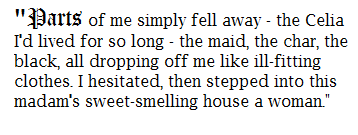
Celia, mother of three, must work as a maid in South Africa in order to sustain herself and her children, two of which live with their grandmother. Miriam, her youngest child, lives with her in the white family's house and Celia must care for this young girl whilst performing all of the duties expected of her. 

However, once Michael and Rita, Celia's employers, have a stillborn baby and realise that child bearing may not be a thing in their future, they begin to look at Miriam in a new light. Informed that they will take Miriam to England, and bring her up in an economically stable environment, or she be forced to find a new job and care for Miriam, Celia does what she feels is best for her child. Breaking her own heart, she hopes that Miriam will be happy. But, living in a predominantly white area and being outcast as an outsider at school in England, Miriam longs for home. As she grows older, Miriam realises she needs to find out more about her real identity, and begins a journey back to Africa. But, will there be more surprises than anticipated in Miriam's journey to self-awareness?


This wasn't the quickest page-turner for me, but as I said, it was good to read something with a little more depth to it. However, I'm someone who is oddly affected by the mood of a book, and so much of this was an endless depressing battering of any hope. This personally made it harder for me to want to come back to. And yes, I do get that books can't always be happy-go-lucky, but when the 17th thing in a row went wrong and smacked Celia or Miriam in the face I felt like flinging my kindle across the room. But, that's a miniscule percentage of the frustration that being in Celia or Miriam's position would have produced!

Have you read it? What did you think?
Steph x

Sunday, 29 March 2015

Review of 'Oroonoko'

When I think about literary texts on slavery, I never really consider English 17th Century ones, however, Aphra Behn's Oroonoko is radical for this alongside many other reasons. It is written by a woman, and was one of the first novels, albeit more of a novella, in English literary history. The quotation above highlights the inherent racism in it, however, as a 17th Century text it is often very forward-thinking, and approaches the issue of slavery in a much more sympathetic light than many 19th Century American texts written by a white author. 


Oroonoko is a mighty and beautiful prince. He comes back from a war and falls in love with a beautiful and intelligent woman Imoinda. He makes his intentions to have her as his wife clear. However, the king of the land insists that she becomes one of his concubines. Oroonoko and Imoinda are heartbroken at this shameful separation and eventually succumb to their desire for one another. When this happens the king sells Imoinda as a slave and she is sent overseas, yet tells Oroonoko he has had her killed. Later, Oroonoko is captured as a slave. When the pair meet once more on a plantation who knows what they will do?


This was a very powerful text for me as I mentioned in the beginning. Many critics have argued about whether this book is a celebration or critique of slavery. I found it more erred on the side of a critique, but what did you think?

Steph x


Monday, 23 March 2015

Review of 'Marina in a Green Dress

(image taken from goodreads)


As a child, Walt Disney taught me that 'if you don't have anything nice to say, don't say nothing at all' (in the words of Thumper), so I'm going to keep this short and sweet. I picked up Marina in a Green Dress a couple of weeks ago as it was free to download onto my kindle and I wanted to go for something I hadn't really gone for before. Now I have to say I slightly regret it, and was pretty disappointed. The idea of a book based around a female protagonist who loves musicals sounds awesome, but in reality I don't think this one really worked out.


Jessica moves to London in the hope to get away from her restrictive Northern parents who believe that education and university ought not be everyone's top priority. She goes to see her favourite musical, 'Marina' on a regular basis, much to the chagrin of her boyfriend Steve. However, when a joke letter asking the lead actor of the play to meet her gets sent, Jessica's life changes irreversibly. It's up to you to decide whether it's in a good way, or this is taking her down a darker path ....

This just didn't hit the spot with me. I felt as though I could not in any way connect with the protagonist, which I find really spoils a book. Her thoughts and actions baffled me, and I more frequently felt as though i sided with the reason of other characters in the book.

Have you read it? Did you enjoy it more than I did?

Steph x


Tuesday, 24 February 2015

Review of "The Man of Mode"

The above excerpt from this 17th century play sounds like it could have come out of the mouth of Lady Macbeth, however, writing over half a century later, the playwright Etherege had quite a number of different aims in his portrayal of the scorned women. The political climate of Etherege's writing was one of libertinism. Charles 1 had been killed and a spirit of puritanism had entertained the interregnum, but with the Restoration seeing Charles II put on the throne, a period of somewhat licentious behaviour ensued. Charles II was known for his many mistresses, and if you've ever read any of Rochester's poetry, you'll know how, let's say "saucy" Restoration literature can be! 

Dorimant, a man of wit, convinces the town that through the contraction of a venereal disease he has become impotent. In this way he can allow men to let him have access to their wives, believing that he can do them no harm (the rogue!). Mrs Loveitt is one of the first to fall under his wiles and realise that she desires him. After this, women seem to keep falling into his trap. Sir Fopling Flutter on the other hand, as his name suggests, is the foppish laughing stock of the play - misplaced attempts at wit, unfashionable clothing and outdated speech make him far less desirable to the women. The real question of the play is: will Dorimant's trickery be discovered? And by the men or the women of the play?


This play really made me think about how restrictive Victorian literature has been on the notion of sexuality, especially female sexuality. All of the women in this play display some level of sexual desire, even if it is misplaced in this man of supposed impotence. However, Mrs "Loveitt"s name in particularly gives a slightly negative outlook upon the notion of women chasing after men they desire. The complex natures of the women were also interesting as again, in later English literature this seems to have disappeared a tad. Here the women are at once devious, loving, skeptical, chaste and yet sexual creatures.


Rating:


Have you read it? What did you think?
Steph

Tuesday, 3 February 2015

Review of "Cometh Up as a Flower"

Utter madness isn't it *heavy sarcasm*, but for a book published in 1872, this quotation is pretty wild. I've read a lot of 19th century novels over the past few years, and quite a number of the heroines are somewhat lacking in a number of things: independence, a brain, passion and their own opinions to name but a few. Nell in Rhoda Broughton's Cometh Up as a Flower, however is something else - she actually defies feminine stereotypes and scorns the company of other women.

Nell lives alone with her father as her mother died when she was young. Despite their family name being one of high rapport, the Lestranges have gone way down the social ladder in recent years, to an extent that bills are unpaid and Nell's father's health is rapidly declining under economic stress. Nell meets a poor man called McGregor: handsome and flirtatious, he conducts an illicit relationship with her, which is kept a secret from her father. But, when her elder sister Dorothea returns to the family home, things begin to go a bit awry. Is love really worth more than money?

Although this book was written over a century ago, its language is not difficult or burdensome (makes a change for a 19th century novel, right?!). Nell's character is incredibly complex - she has a whole number of ideas concerning the social status of women in England, and has a number of factors which govern her every thought. Her sister Dorothea similarly offers a unique and often perplexing character: driven largely by money, she corrupts everything that is good in the novel and comes across as a true villain. This text really explores what your priorities ought to be when deciding who to marry. It also exposes some harrowing truths about the 'choice' even seemingly independent girls like Nell have concerning marriage. All in all, if you're interested in a look at how advanced first wave feminism could be in literature, this is a great text to go to!

Have you read it? What did you think?

Steph


Wednesday, 7 January 2015

Review of "A Drunk Man Looks at the Thistle"


The quotation above pretty much describes my current mood: "I am not so much drunk, as tired - dead done". The first few days back at uni have been exhausting - meal prepping, unpacking, going to lectures and seminars, going to the gym, and trying to fit in time for some actual uni work and reading as well! I'm currently sat in bed with a toasty mug of green tea, in some new fluffy PJs hoping that tomorrow is less hectic. 

As you've probably already guessed, this book isn't the easiest in the world to read. It's in fact a long poem written in vernacular Scottish - imagine coming across a drunk Scottish farmer in a rural area and you've just about got the gist of it. Oh, and get that farmer to translate the odd Russian poem into Scots dialect here and there. The entire text is purposefully de-anglocentric, as MacDiarmid was calling for a Scottish Renaissance in terms of literature. To move away from the static resonance to English literature in Scottish fiction was most definitely the way forward in his eyes.

I have to say, this wasn't a book I would necessarily read if I didn't have to. Having said that, it's really the only text by a Scottish author that I've ever read which defies English literature, and stands up in opposition to it. The whole notion that Scottish people do not have a language of their own, which pervades the entire poem, really pointed out to me something which I'd never thought about before. Moreover, if you want to read some fantastic imagery concerning thistles (a bit niche, but hey ho), then check it out!

Have you read it? What did you think?
Steph 

Friday, 12 December 2014

Book-A-Day #11 & #12 | Christmas Classic and Book of Poems


So, I've already failed in keeping up with doing this everyday, whoops! I had a bit of a hectic day trying to do research for an essay (and watching What Happens in Vegas with pizza). But, I'm making up for it today!

Harry Potter will probably always be my most Christmassy of reads. I don't think anybody can read them and not remember the hideous jumpers that the Weasleys receive every year out of the kindness of their mother's heart. Or Harry's invisibility cloak. I also don't think you can read them without wanting to spend a Christmas at Hogwarts. Their Yule Ball and atmosphere is just so lovely. Plus, y'know, the films are always on here in the UK over this period.

Now, Hardy's poems are one of very few books of poems I own, though he's far from my favourite poet. Donne takes that title. I'm gonna leave you guys with my favourite ever poem here, cause I think it's something everyone should get the chance to read. And, if you want to check out something a bit raunchy for a 17th Century poem, go to his "The Flea", or the majority of his short poems!

The Broken Heart

He is stark mad, whoever says,
    That he hath been in love an hour,
Yet not that love so soon decays,
    But that it can ten in less space devour ;
Who will believe me, if I swear
That I have had the plague a year?
    Who would not laugh at me, if I should say
    I saw a flash of powder burn a day?

Ah, what a trifle is a heart,
    If once into love's hands it come !
All other griefs allow a part
    To other griefs, and ask themselves but some ;
They come to us, but us love draws ;
He swallows us and never chaws ;
    By him, as by chain'd shot, whole ranks do die ;
    He is the tyrant pike, our hearts the fry.

If 'twere not so, what did become
    Of my heart when I first saw thee?
I brought a heart into the room,
    But from the room I carried none with me.
If it had gone to thee, I know
Mine would have taught thine heart to show
    More pity unto me ; but Love, alas !
    At one first blow did shiver it as glass.

Yet nothing can to nothing fall,
    Nor any place be empty quite ;
Therefore I think my breast hath all
    Those pieces still, though they be not unite ;
And now, as broken glasses show
A hundred lesser faces, so
    My rags of heart can like, wish, and adore,
    But after one such love, can love no more.


What would your choices have been?

Steph

Tuesday, 14 October 2014

Trip to the Home of Shakespeare


(Shakespeare's last house)


I realised that, as a third year English Lit student at Warwick, it's pretty shameful that I haven't been to visit Shakespeare's home in Stratford-Upon-Avon (which is just a relatively quick train ride away). So, a group of us who studied Shakespeare last year set off full of excitement. As you would expect for October in England, it rained on us. All day. But the gaudy lights of the massive fair we stumbled across in the centre of the town cast away the damp blues and created a brilliant atmosphere.

The quote at the top of the page was one of the most interesting things I saw in the Shakespeare Centre. Hidden amongst innovative sculptures and paintings of the infamous playwright himself from all over the globe, this served as a reminder of the long-lasting cultural impact Shakespeare has had. Although I knew that some of these were down to him I had no idea that he'd formed this large a part of our vernacular. 

The houses themselves were beautiful. The detail and care in which the people who worked there spoke about and looked after the furnishings of the house was just astounding. Plus Stratford itself was just adorable. I'm always a fan of old houses. Even if we did end up lunching at Zizzi's, looking at all the little independent restaurants just added to the atmosphere. Our last stop was an old-fashioned sweetshop. Who isn't a fan of these? You walk in and the shelves are lined up to the ceiling with jars of a huge array of sweets. Heaven.

Anyway, if you're thinking of going, or are just a fan of Shakespeare I'd highly recommend it. They've got a whole host of little activities to keep the kids entertained as you explore the houses, Plus the giftshop has everything any self-respecting bookaholic who likes Shakespeare would love (I had to restrain myself from buying a Shakespeare advent calendar - where else would you find that?!)

Steph x


Thursday, 7 August 2014

Review of Silence

Natasha Preston's first book in her "Silence" series (appropriately named) raises a great number of important questions surrounding the moving issue of childhood sexual abuse. Despite a pretty good (albeit cliched) romantic back story to the plot, the writing completely dragged down my overall impression of the book. My kindle edition unfortunately also had quite a number of spelling and grammatical errors and typos. Though this was obviously not a bad feature of the book itself it too detracted from the strikingly good storyline. 
Silence follows the stroy of 15 year old Oakley who hasn't uttered a single syllable since the age of five. Her overwhelming love for her 17 year old best friend-stroke-neighbour-stroke-all round good guy Cole encourages her to consider the impact of her silence on others including her family. Oakley, her loving parents and sex-obsessed brother Jasper make up the Farrell family unit. But as the novel makes clear, Oakley's silence isn't the only aspect of their family's lives which doesn't immediately meet the eye ...
Set in England, the social issues which this novel raises really struck home. Moreover, with the recent numerous allegations of child sexual abuse by men in the medial business, this novel is at the heart of heated discussions in the UK. The most important aspect of this novel, I believe, is the exploration of the ways in which sexual predators transform their victims in order to cover up their horrendous acts against human decency. Oakley has her voice physically taken away as a hyperbolic symbolization of the fear in which these victims live. The question it most potently raises is: how does one grow and adapt to deal with normal life after life-destroying incident like this have taken place?
So, once you get past the somewhat awful writing and the lack of suspense in the novel (the author reveals the nature of the cause of Oakley's silence in the first few chapters), Silence develops into a heart-warming, tension filled novel.

What were your thoughts?

Saturday, 19 July 2014

Crime and Bleak House

Charles Dickens' fictional novel Bleak House was originally published in serials. It explores both social and legal crimes, appearing to set them up in conflict with one another. This allows him to pose the question to the reader: which type of crime is worse? Do we see (spoilers, but it was written quite a while ago) Esther's bastardization as a result of Lady Dedlock's youthful sexual liberty as something inherently more immoral than Mr Tulkinghorn's murder? My answer is no. Dickens is known for his exposés of the physically and metaphorically filthy state of London in the nineteenth century. This novel appears to occupy a similar strand of argument, which means that it examines the implication of social crimes upon legal ones. Thus, Lady Dedlock's sexual activity cannot be viewed in a light which puts all other plot strands to darkness: all other crimes are in some way involved with it, to the extent that Mr Tulkinghorn's murder could even be said to be caused by it. 
Lady Dedlock's sexual crime, by which she decides to engage in premarital sexual intercourse with Captain Hawdon, is also a domestic crime. This crime is inextricably linked to the haughty mask of secrecy which controls Lady Dedlock's domestic life. Although at first it appears that her aristocratic snobbery allows her to occupy this position of aloofness, it is eventually revealed that it is crippling shame which induces this facade. She maintains this cool exterior by flitting from place to place, refusing to fully engage herself in her life. Lady Dedlock continues to live in this manner for a number of years until Mr Tulkinghorn invades her domestic sphere with a vicious sting of truth: her past. Tulkinghorn's revelation to Lady Dedlock of his knowledge of her youthful sexual affair is central to the criminal strand of the novel's plot. Once this invasion has occurred, the social order which the reader experiences at the beginning of the novel can never be restored. Thus, this indicates that the theme of this Victorian fictionalisation of crime is the secrecy of the home's problematical relationship with the public sphere. Indeed, Lady Dedlock is not initially aware of the long-lasting consequences of her affair: Esther, her daughter, is alive! Once this is revealed, her life becomes fraught with tension. Lady Dedlock is no longer able to feel "at home" in her stately mansion because her sexual "crime" has made her unworthy of such a high social position. 
Furthermore, questions surrounding Mr Tulkinghorn's murder are at first seemingly unanswerable because of the number of enemies he has made by collecting peoples' domestic secrets. Indeed, his own secrecy is involved in the seemingly impossible nature of the inquest as nobody knows to whom he was attending on the evening of his murder. Mr Tulkinghorn's death, in parallel to his life, is shrouded in mystery. His death, and life for that matter, is, moreover, at the heart of all of the criminal strands of the complicated plot of Bleak House. He represented the watchful eyes of the public social sphere upon Lady Dedlock's life. His invasion of the secrecy of her home led to his murder. In addition, the death brings a number of minor criminal figures out from the shadows of crime-ridden London. Mr Smallweed, Hortense and Mr George are all characters with questionable moral qualms, and all have committed some crime, whether it be legal or moral, in the novel. In this way, Mr Tulkinghorn's murder ironically results in the invasion of the secrecy of his home by representatives of the public sphere.
Moreover, there is an interesting link between women and crime in the text as it is Hortense and Lady Dedlock who arguably commit the greatest crimes. In Victorian culture, women were expected to occupy the domestic sphere: this provides another (albeit tenuous) link between domestic life and the fictionalisation of crime. Hortense is a maid, which means that her role in society is to invade the secrecy of the home. She occupies a peripheral position in the house as she is both integral to its pragmatical functioning and unnecessary to the family emotionally. Hortense's lack of understanding of the position which she occupies is revealed in her childish indignance at losing her place as Lady Dedlock's favoured female companion. Hortense's vengeful plan which she enacts as a result of this is incredibly detailed and cunning. This shows that if the secrets of the house are revealed to the public sphere, serious crimes can abound in Victorian London. Moreover, Horetense's plot to frame Lady Dedlock would have been successful had she not been residing with Mrs Bucket - the detective's wife - at that period of time. A crime can therefore only be successful is it remains hidden from other members of a household. 
Furthermore, Mrs Pardiggle's unmannerly invasion of the brickmakers' homes reveals the presence of domestic abuse to both the naive wards of Jarndyce and the reader. The black eye which Liz sports and her husband's drunk, aggressive behaviour are designed to imply that he beats her. Had Mrs Pardiggle not have entered the house, this awareness would not have been made public in the novel. Indeed, Liz and her friend Jenny, a fellow brickmaker's wife, suffer from a great deal of physical and emotional abuse from their husbands to the extent that they are made penniless, voiceless and powerless to do anything about it. 
What are your thoughts about crime in Bleak House?

Thursday, 17 July 2014

A Review of Lady Chatterley's Lover

https://blogger.googleusercontent.com/img/b/R29vZ2xl/AVvXsEjzLPGlASTz6tXtSw0kgR8dH-dmAb2XWXsiRPca3GDaN3WbRzq4TkaNrywtysycFCvrnZeIIaDMX3gAHyaJX7Q3JuejWMbvp1spIfjBguzX4UUDskOS0R7NbmoqI51NSC5mcw9X4YluTZKB/s1600/timthumb.jpg

D.H. Lawrence's Lady Chatterley's Lover is not only an important book in terms of its literary merit, but also its socio-historic impact upon England's publishing world. Although the novel was written in the 1920s, an uncensored version was not published here until 1960. Even then it caused a great deal of scandal: Penguin, the publishing house for the text, was forced to undergo an obscenity trial due to the explicit erotic language and themes the book contained. they fought for the literary merit of the book and the case was concluded with the verdict "not guilty". This makes Lady Chatterley's Lover a key implement in British authors' attempts to discuss erotic concepts in modern texts. 
The story commences with the tale of a sexually licentious girl who marries Sir Clifford briefly before World War I. He returns from the war paralyzed from the waist down. This allows Lawrence to broach the the uncomfortable and forbidden question at the back of everyone's minds: "does it work?". Unfortunately for Sir Clifford, the answer is no. 
Connie, or Lady Chatterley, becomes depressed as a result of their sexless, joyless marriage and begins to seek a lover to satisfy her maternal cravings for a child. This plot is ensconced in a Hardy-esque condemnation of the industrialization of England, as well as a self-conscious examination of class differences.
Despite hearing mixed reviews for the book, I don't regret picking it up (or rather downloading it to my kindle) at all. The book is a pastiche of genres, which I believe is a reason why it doesn't sit well with many readers. It has a great focus on man's connection with nature, which is emblematic of Romantic writing, whilst displaying the futility of human life, terse vocabulary, and lack of sentimentality of modern writing. 
The first portion of the novel seems rather dry and hard to digest. Yet, this appears to merely be a stylistic mirroring of Connie's sexually barren state: once she secures a lover the writing becomes more poetic and much more enjoyable. Though Connie is hardly a likeable figure, doesn't modern fiction often strive to teach us that people cannot be labelled as being good or bad, but rather are more complicated?
So if you want an easy to read, yet important piece of fiction to add to your "To Read" list this summer, pick up Lady Chatterley's Lover​ and give it a shot!
Love, Stephanie