Showing posts with label feminism. Show all posts

Tuesday, 19 February 2019

Review of 'Mrs Dalloway' by Virginia Woolf

'It might be possible that the world itself has no meaning' - Viriginia Woolf

I've been meaning to read some Virginia Woolf for the longest time, and whilst a number of her books line my shelves I've always been way too intimidated (and kinda scared of disappointment) to pick one up until now. 

Much like Ian McEwan's Saturday, (though a LOT better in my opinion), Mrs Dalloway takes place over the course of a singular day. Clarissa Dalloway, our main character, is planning a house party and wanders around preparing things for it, reminiscing over her youth. She considers her choice to wed the 'safe option' rather than pursue a relationship with the slightly wild (and more sexy) Peter Walsh. The novel culminates in the party, at which a friend's suicide is announced, and Clarissa wonders if he made a better decision than the one she took to stay alive.

Laying out the plot like that, it all seems a little dull, but for a novel of its time (published in 1925, the same year as The Great Gatsby), it really is something. One of the most shocking bits for me was the hint at Clarissa's bisexuality. As well as mentioning that Peter Walsh was an option to her, she looks back fondly on a kiss with Sally Seton, who she declared as being obviously not an option. The kiss was the happiest moment in her life. I've tried to rack my brains and I can't think of another book that I've come across older than this where a more-than-friends relationship between women is mentioned without it being used in a 'God will smite you' manner. 

The other issue discussed is shell shock and the PTSD surrounding that. Not only is this explored in some depth, but it's done in a caring way. It actually shed a whole lot of light for me on the impact of 'shell shock' and what those words actually mean. The book discusses how hard it is to integrate with society post-war.

I really can see why a lot of people love Woolf and I feel like reading this might just be the start of a full on love affair with her work. If you've got a favourite novel of hers please pass on recommendations!

Follow me on Bloglovin | Twitter | Instagram | Youtube


Saturday, 29 September 2018

Review of 'The Vagina Monologues' by Eve Ensler

Review of 'The Vagina Monologues' by Eve Ensler

Towards the start of 2018, I set myself a book bucket list of all the things I wanted to read this year. It's been a while since I read a play, and I kind of miss it, so The Vagina Monologues took pride of place as the only play on the list. I've heard amazing things about it, which made me worried that I'd be let down when I read it, but this was so far from the truth. 

The Vagina Monologues is one of the most thought-provoking things I've read all year. It made me reconsider my own body, the political landscape that my body fits in, and why we should celebrate all women's bodies. It brought things that I always knew deep down out into the open where I could really consider them. For instance: body hair and its politicisation. I know body hair is politicised, I know that women used to be happy to have body hair everywhere until razor companies started targeting us to double their profits (a true story). But, I'd forgotten how much stigma comes with any kind of body hair: pubes and you're dirty, armpit hair and you're a raging feminazi, no hair and you're no longer a virgin. And we never stop to think about the weird insistence on going back to this hairless childlike state, and why it's so appealing. 

This is just one of the topics that the book covers. It also looks at domestic abuse, sexual abuse, childbirth, masturbation, sex, etc, from a whole range of different perspectives. My one warning for this book is that if you're a victim of sexual assault, the monologues in this book may be triggering. 

I'm so grateful I read this, as it completely opened my eyes to a whole range of things. There was an incredible foreword by Gloria Steinem in my copy, which absolutely made the book ten times better and helped to explain the fundamental theories behind the monologues, and give them a bit more substance.

This book could be quite triggering, as previously mentioned, but I really do thing it's a very important thing for all genders to give a go, to understand the politics and depth of meaning behind the mighty vagina.

Have you read it? What did you think?

Follow me on Bloglovin | Twitter | Instagram | Youtube

Tuesday, 6 June 2017

Review of 'Maria, or the Wrongs of Woman' by Mary Wollstonecraft

Review of 'Maria, or the Wrongs of Woman' by Mary Wollstonecraft

We've all heard of Mary Shelley's Frankenstein, but Shelley's mother's literary-political works are much less well-known. Today I'm going to be talking about one of them. Maria, or the Wrongs of  Woman is an early radical feminist novel, which unfortunately has no ending. There are several fragmentary endings, but none are complete or fully coherent, as the author died before she had finished the work; it was published posthumously by her husband. 

The novel commences with Maria in an asylum. Her husband has placed her in there, as she attempted to flee his control, and has seized her child. Maria is completely sane. The woman who waits on her, Jemima, soon comes to realise this, and sneaks books in for her to read. These she shares with a fellow inmate Dartford. He's been put in the asylum because of a night on which he drink far too much; he too is sane. The pair begin to communicate through writing on the margins of the texts they both read. 

Soon, Maria begins to fall for Dartford. He becomes more and more intrigued by her character and ultimately requests her to spell out her past to him. Maria's husband seemed like a wonderful man prior to their marriage, but she soon realises that he's a libertine. As well as spending all of their money with no cares, he repeatedly cheats on her. Maria draws further away from him, and the idea of having sex with him becomes abhorrent. He forces himself upon her and Maria gets pregnant. Things are getting worse and worse, and Maria knows she needs to get away, but the social climate simply won't allow it...

Have you read it? What did you think?

Wednesday, 31 May 2017

Review of 'The Story of an African Farm' by Olive Schreiner

Review of 'The Story of an African Farm' by Olive Schreiner

Whenever I read a novel from the first-wave feminism era, my reaction is generally split into two: I'm either shocked at how forward-thinking the novelist is, or appalled at how restricted their thinking is. The Story of an African Farm falls into the former category. 

As it's part of first wave feminism's literary movement, although the novel is set in Africa, we don't see any intersectional feminism. It's very much about a Dutch white family living in South Africa and how they approach feminist ideals.

At the beginning of the novel, the three protagonists Em, Lyndall and Waldo are children. Waldo is an overtly Christian boy, who believes in the teachings his father passed down to him, whilst Lyndall constantly expresses more modern ideas about the world she lives in. 

Lyndall leaves the farm to study at a boarding school, but comes home disheartened at the fact that they teach her 'women's duties' such as sewing. She wanted to learn about the world, become more adept in mathematics and scientific study. Back at the farm, Em has fallen for a man named Gregory, who loves her easy feminine acquiescence and mannerisms. He hates Lyndall when he first meets her: she is abrupt, outspoken and 'unwomanly'. But soon he sees a charm in her that he overlooked at first. Now Gregory falls for Lyndall.

Gregory asks for Lyndall's hand in marriage. She however, has other ideas. Lyndall does not plan to get married, ever. She's in love with a stranger, whom the others have never met, but tells Waldo that she intends to cohabit with this man. She does not wish to marry as she wants both herself and her lover to be free to move on if the relationship wears thin. This was obviously quite a revolutionary idea at the time, and it's interesting to see how Schreiner lets it play out.

Have you read it? What did you think?

Saturday, 25 February 2017

Review of 'The Subjection of Women' by John Stuart Mill

Review of 'The Subjection of Women' by John Stuart Mill

John Stuart Mill is a name that has been bouncing around my ears for years. First he was a big figure on my A-Level Ethics course, and then he popped up again on my first-wave feminism studies module at uni. The Subjection of Women was first published back in 1869, and I imagined it would be so dry (read: Mary Wollstonecraft-esque) that I just skipped over reading it, but now that I've come back to it I can see how powerful it really is. 

The best (or worst?) thing about it, is that it lays out feminist goals in simple terms, and shows how little we've completely achieved. Mill calls for the social, political and economic equality of the sexes. And that's what we're still fighting for. He asks that marriage be determined on equal grounds: women should retain their own property and have the ability to be heirs in their own rights. 


The greatest focus of the essay is upon marriage, and as such he goes into great lengths about the equality of partners within marriage in the eyes of the law. He suggests that women ought to have the right to divorce a husband on the grounds of abuse, and that they ought to have hold over their own money.


This long essay went against much of European conventions at the time. Reading it from a modern perspective makes you notice how forward-thinking Mill was. Still we often have inequality within marriage: women are required by tradition to take a man's name, and often expected to bend to a man's will, like the quotation above suggests. 

Mill also defended the intelligence of women, making the logical claim that there would be more successful female scientists and mathematicians if as many women as men studied the subject. He disputed the argument that women have smaller brains and smaller intellects because of the size of their heads also. 

If you want to get to know more about first wave feminism I would definitely recommend not doing what I did and skipping over this, but going for it as it truly was very eye-opening.

Have you read this? What did you think?

Tuesday, 21 February 2017

Review of 'Ruth Hall; A Domestic Tale of the Present Time' by Fanny Fern

Review of 'Ruth Hall; A Domestic Tale of the Present Time' by Fanny Fern

Although I love reading older novels, it can sometimes be really hard to relate to them. We no longer live in a world where we need chaperones to wander around, or where you can only travel by foot, horse or train, or where you have to send letters to contact people. But the issues involved in this book are things that I still come into contact with all the time. It was startling, but nice to finally be able to properly connect with a female protagonist of the 1800s.

The novel opens just before Ruth Ellet marries Harry Hall. She's lucky: they genuinely love each other, and the match is a good one. Her family have money, but are only too glad to get the only girl of the family off of their hands. The Halls are not as wealthy. After their marriage, Ruth and Harry make do with the little money they have and are happy. They have their first child, and she is a wonderful creature, but dies young. Ruth is devastated, and struggles to recover from her grief.

Behind the backdrop of this family unit, is a pair of overbreaing in-laws. Harry's mother criticises everything Ruth does; she insults her housekeeping, spies on her, critiques the way she brings up her children, and has no sympathy for the mother who has lost a child. 

Soon Ruth and Harry have another two girls, and the family is becoming more financially stable. Ruth is happy. Suddenly Harry is struck with an illness. His parents won't take it seriously, and by time the doctor is permitted to be called it is too late. Harry passes away and Ruth is left alone to look after their young girls. But what about the Halls who always wanted more involvement in the pairs' marriage? They don't think they ought to support the young widow - she's not their child after all. Despite being very well off, Ruth's father and brother considered her done with: they felt that as she had married into the Hall's family, she was not their concern anymore. The village that her and Harry lived in loved the little family so much that they raised money for the poor widow, but her brother took it, vowing he would give it to her himself, yet he never did.

Ruth is forced to live on a pittance that her father guilt trips her about endlessly. It's hard for a woman to find work and she goes into poverty stricken lodgings. Ruth tries a variety of forms of work, but she is too physically weak for manual labour: grief has hit her hard.

Soon, Ruth struggles to raise enough income to support both children, and reluctantly agrees to allow her eldest to live with the Halls. She is determined to improve her monetary situation and get her daughter back asap. Ruth finally turns to writing, and after a long and strenuous toil begins to achieve some success from it. Writing saves both her mind and body.

I loved this book so much. Overbearing in-laws are the bane of my life, and I felt like I knew exactly how frustrated Ruth felt. It was also fab to see a girl win her own place in the world, and prove everybody that tore her down wrong. If you want a feel-good classic that's not as long as a Dicensian novel, or as wordy as a Hardy, then I would 100% recommend giving this a go.

Have you read it? What did you think?

Monday, 6 February 2017

Review of 'Coelebs in Search of a Wife' by Hannah More

Review of 'Coelebs in Search of a wife' by Hannah More

It's a bit scary that some people still adhere to the beliefs within this statement, which was written over 200 years ago. As you can probably guess, I wasn't the greatest fan of the morals set out within this novel, but yet I wasn't the least fan of it either. It's set worlds apart from the modern day, and despite this quotation being largely negative, it was actually seen as a feminist novel in its heyday. 

It largely looks at how to parent young girls, which was a bit of a risky topic back then, as it is now. Coelebs is looking for a wife (as you may have guessed), but every woman he comes across is too 'something'; they're too religious, or too dowdy, or too loose in their morals, or spend too much time reading novels (whoops). 

Coelebs' dying father asks him to spend some time with an old friend, Mr Stanley, after he passes away. Coelebs does this and is struck with the wonderful way in which Stanley raises his children, in particular his eldest Lucilla. They are taught from a young age that, though they are a family of means, the girls must do charitable work for the goodness of doing it, not for any praise or reward. They raise their own garden together, and sell the flowers they produce to raise money for the infirm in their area, or give the flowers for the poor to sell themselves. They are taught all aspects of domestic life and come to love them, as well as being competent in other pursuits such as singing and instrument playing.

All in all, Coelebs begins to see them as ideal women. And he falls in love with the eldest Lucilla, but does not know how to reveal this to her father. When he does, Mr Stanley tells Coelebs a tale that shocks and thrills him (as well as the reader)!

Have you read it? What did you think?

Wednesday, 30 November 2016

Review of "Reuben Sachs" by Amy Levy

Review of 'Reuben Sachs' by Amy Levy.

It seems like forever since I've sat down and written a review on here, and I've practically got a mound of books read and ready to be reviewed, but I just haven't found the time recently. It's been well over a month since my last review, so I thought I'd kick start me getting back into the swing of things (hopefully) with a Victorian novella.

Reuben Sachs was on my course list for a module in first wave feminism when I was at uni, and sat alongside the likes of Dracula and Goblin Market, but it simply looked so dry that I never quite managed to get around to it. 

Now that I've read it, I can see how these texts all interlink in their analysis of the 'modern' female in the Victorian Era. Reuben Sachs focuses on a young girl, Judith, rather than the novel's eponymous male protagonist. Adopted by her auntie and uncle, as her family is too poor to raise her, Judith is brought up in a world of wealth without actually having any to her name.

This Jewish family is completely, unapologetically aware of the conflicted position Judith is in. She is at once rich and yet poor: she wants for nothing and yet her future looks bleak. Due to her lack of wealth, any potential husband that she may meet in the circles that she occupies is likely to reject her for a more wealthy wife. Indeed, her adoptive sister, who does have a dowry from her parents is a more suitable candidate for marriage than Judith is.

Unfortunately for Judith, she falls for her cousin, Reuben Sachs. Although he falls in love with her too, he casts aside his passion in order to pursue his political ambitions. Every time the pair meet they are torn between love and duty, and it is always duty that wins. 

Have you read this novella? What did you think?

Thursday, 10 December 2015

Review of "A Spool of Blue Thread" by Anne Tyler


Even the very title of this novel screams that it is quintessentially American. Set deep in the heart of the country, the key protagonist Abby is a mother first, a wife second, and a money maker last. This book is almost what I would call a reverse bildungsroman (if such a thing exists): we start off with a retired Abby who still struggles to understand her problem child Denny, and then we move back to how she met her husband Red, and even further back in time to how his parents met. Eventually the reader learns that out of happiness, happiness does not always emerge, and out of unhappiness it is possible to find joy. 

Denny has always been a problem child, yet in spite of that. or perhaps because of it, he's always been Abby's favourite. But what happens when a problem child grows up and becomes a problem adult? Does it get any easier for a mother? And what about the rest of her children? Abby is mother to Jeannie, Amanda, Denny and Stem, as well as grandmother to numerous children, and loves being the centre of their little community, as well as the fact that they all live nearby. 

Unfortunately, Abby is starting to age, and as the family gather closer together, we find otu everyone's real intentions with being part of the family, and their true colours are displayed. But when we delve deeper into Abby's memory we learn that perhaps even seemingly the closest of families can be worlds apart.

Have you read it? What did you think?

Steph x

Sunday, 4 October 2015

Review of "Am I Normal Yet?" by Holly Bourne


All Evie wants is a normal life. But how can she hope to have one when she's trying to adapt to life with a serious mental illness? In this paradigm-changing novel, Bourne imagines what it's like to be a teenage girl who genuinely suffers from OCD to a potentially life-threatening extent. We follow Evie in her journey to college and what she sees as normality: friend , boys and parties. Evie cannot even fathom life in which this is a normality for her, but what if it is possible?! Through this harrowing tale of relapse and recovery, Bourne makes no attempts to glamourise mental illness, instead exposing it in all of its life-ruining glory. 


A fresh start. That's what Evie wants from college: a place where no one knows her as "that girl who went mental and ended up in hospital". Plus, she's still got her best friend Jane who stuck with her through everything to keep her on the straight and narrow. But when Jane gets a new boyfriend and is suddenly inseparable from him (even their personalities are now joined at the hip, eurgh!), Evie feels more isolated than ever. That is until Lottie and Amber come along, making a trio called The Spinster Club with Evie, changing the definition of the word for good. Gone are the days when the girls depend on boys for happiness; now, they celebrate their singledom. However, Evie starts to fall for a boy, and what happens when she feels like she can't stay true to her feminist roots? Finally, when old habits start creeping back in, will she be consumed by her mental illness or triumph?

Have you read it?
Steph x


Saturday, 25 April 2015

Review of "The Turn of the Screw"


This is pretty much the most psychological gothic novel I've ever read. If you want to read something that will really make you question what's real and what's not, then you need to check this out. In comparison, other gothic novels like Dracula and Frankenstein are CSI and this is more Goosebumps (who didn't read about 50 of those when they were younger?!). Anyway, I've recently written on this for a university paper comparing it to The Yellow Wallpaper, so if you've read both it might be interesting to think about ways in which they're similar as they were both written by American authors in the same period.

A group of friends gather around a fire to hear ghost stories - but one participant claims he has a true one, taken from the diary of the governess at the heart of it. When the governess arrives at her new job, she is charmed by the distant uncle of the two children she is to care for. Meeting the unbelievably beautiful children Miles and Flora, she is shocked to discover that Miles has been expelled from his school for an unnamed reason. However, as the novel progresses and the governess begins to see the spectres of two socially transgressive deceased servants, she begins to wonder whether the children are as innocent as they seem. 

Never knowing exactly what is going on makes everyone anxious, and the amount of critical debate over whether the spectres actually exist or not highlights just how much James leaves to the imagine in this text. 
The critique of American family values and strictures comes through evidently in the discussion of the role of both the governess and Miles' social transgression. Queer discourse is snuck into the heart of the story, which is always enlightening to witness. This is what is the great unspoken crime of the novella, and bathos is used when it is finally exposed. In this way, James indicates that by not using queer discourse, we don't avoid it, but create anxiety around it.

Have you read it? What did you think?

Steph x

Friday, 17 April 2015

Review of "Dracula"

(image taken from Oxford University Press)


Dracula has been on by TBR pile for about seven years. As a fan of the Gothic I should have got round to reading this yonks ago, but I finally managed it a few weeks ago. And wow, do I regret not having done so before. This is most definitely sat in my top ten books of all time, possibly top five. If you haven't read it, I would highly suggest you got out and do so. There's everything you could ever want in there: love interests, underlying sex scandals, gore, the uncanny, well developed characters and incredible writing. 


Jonathon Harker travels from London to Transylvania to conduct a deal with a man living in a mysterious home. When he arrives, he realises it isn't just the fact the man's home which is a little odd. Count Dracula, Harker's host, soon displays worrying behaviour, particularly when he refuses Jonathon's entreaties to leave the castle. Having arranged for the Count to move to London, Harker soon begins to question what he has done when he encounters the count sleeping in a coffin ...

Thus begins a whirlwind of a hunt against time to save the woman of London from this vile predator. Who will win this ultimate battle?


There are so many issues raised about normative gender roles, the idea of a 'foreigner' and sexual orientation in this wonderfully deep novel. The image of blood runs throughout the text, and gets particularly interesting if you think about its relation to both menstrual blood and semen. Moreover,the corruption of sexually innocent women by this life-sucking European exposes a number of fears held by the British population during this period about immigration. The contamination of blood leading to disease also links to the concern about STIs (though not necessarily ones we would immediately think about). 

Have you read it? What did you think?
Steph x

Saturday, 11 April 2015

Review of "The Woman Who Did"

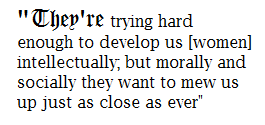
It really is very disturbing how little progress we've made in the face of feminism when you read a text like this that was produced over 100 years ago (published in 1895). The quotation above reflects a number of issues women are getting increasingly concerned about, in that they are having to now be recognised in an academic manner, but often have their behaviour proscribed to them in a moral and social sense. One only has to think about recent anti-rape campaigns, which focus on women changing their behaviour rather than changing the behaviour of potential rapists, to see that we still have a long way to go.

Herminia, son of a prestigious religious father, has rather radical ideas about her future. Rather than marry for love, money, or social status, she wants to join a man of an intellectual equal with her in a perfect union which is not bound by the law. When she manages to do so, and convinces him that this relationship is the way forward, they conceive a child, which they hope will be the advent of a new type of woman and class, in which marriage is disdained and women are man's equal. However, when fever strikes and her man dies, Herminia realises that there were quite a number of flaws to her plan ....


Although it starts off rather optimistic about Herminia's ideals, this text soon becomes tragic and very dark. Herminia was way ahead of her time, and her ideals simply cannot cohere with the world she lives in. With the death of her partner comes financial independence, and as a heavily pregnant woman there is little she can do. A life of poverty is begun, in which she is treated as a tainted woman. Moreover, she casts a dark shadow onto the future of her daughter with the dubious state of the relationship she was conceived in.

Have you read it? What did you think?
Steph x 


Saturday, 21 March 2015

Review of 'The Rover'

This is probably the oldest text I've ever read by a woman. I'm not going to lie, before coming across 17th Century English literature I didn't even know women were able to write published work at this kind of time (kind of shows how repressive some eras were - I'm looking at you, almighty damaging Victorian period). Anyway, The Rover, a play by Aphra Behn, is incredibly expressive regarding the wit and status of women in society during this period. However, this quotation, despite appearing a bit fluffy and cute is actually one of the most troubling I came across in the text. It's spoken by one of the boldest women in the play, Angellica, but suggests that there is an inherent weakness in women that emerges when they fall in love. 

Willmore, or the rover whom the name is titled after is looking for love (or sex, they're effectively the same thing in 17th C fiction). Hellena, whose brother simply wants to send her to a convent and preserve her feminine purity, seeks to get a glimpse into the real world and fall in love. Her and Willmore's paths and hearts meet, however, another figure comes into play: Angellica. Despite being a courtesan, albeit one who insists on a high payment, Angellica is actually not a 'simple' woman as one might expect her to be stereotyped. Amongst a number of other plot lines, you get to see whether Willmore will choose the simple, but alluring Hellena, or the stunning Angellica.

Have you read it? What did you think?

Steph x

Wednesday, 4 March 2015

Review of "Candra's Freedom"*


(photo from harperimpulse)

This is the second in a series of romance-fantasy books by A J Nuest - as I loved the first one (Rowena's Key - check out my review here), I was lucky enough to be sent an e-copy of the sequel. Believe me, after the cliff-hanger at the end of Rowena's Key, I REALLY needed to get my hands on this. Candra's Freedom felt a bit more like a novella to me than a full-blown novel, but with my time restrictions at the moment (imagine me surrounded by mounds of books and reams of paper in a slightly dingy and untidy student room), this was just what I needed for a bit of light reading. 

Rowena finds herself trapped in a castle with no memory or her life before the room she is in. After a number of unsavory advances from her captor, Prince Braedric, combined with the unwavering belief that the people of this mystical place have in her being a sorceress, she begins to strengthen herself for escape. However, this also starts to go downhill with Caedmon returns and states that they're ... betrothed?! And she's expected to love him?! - Fuck that!

This really spoke out to me about female empowerment. Rowena is a strong-headed female protagonist who recognises that she has sexual desires, yet does not allow them to alter her convictions or plans. If you want to read a really realistic (read believable, frustrating, tear-your-hair-out 'why are people like this' moments!) romance that happens to be set in a mystical world, this is your bag. This series is shaping up to be something really spectacular, and I cannot wait to see what comes next!

Have you read it? What did you think?
Steph

Saturday, 28 February 2015

Review of "Out of Work"


You've probably noticed by now that a lot of the books I post about are, to put it lightly, a bit 'obscure'. However, I don't think this makes them any less valuable. As part of my course at university I get the opportunity to read a great number of texts that I otherwise would simply never come across, and although yes, I find some of them terribly dreary, a lot of them are incredibly eye opening. Take this book for example - written by John Law (Margaret Harkness) and published in 1888, it reads like a more easily understandable and shorter Dickens. As a lover of Dickens, I found this fabulous, especially as Law, unlike Dickens, manages to paint semi-realistic female characters! Also, it's full of thought-provoking quotations like the one above, which are alarming in that stereotypes along these lines are things that many girls and women of our generation have heard said to them in some way or another.

Polly Elwin lives alone with her mother and is engaged to be married to Jos, a young carpenter who has moved from the country to secure work. However, this proves harder than he had originally realised, and soon his decreasing funds loses him the respect of Polly's mother and he is no longer allowed to live in the house. Becoming more and more penniless, Jos comes across many issues in 19th C London, amongst them the possibility of a richer suitor seeking out his Polly ...


This book examines the poverty in London in the late 19th Century, alongside the riots it induced. Told from the perspective of an innocent man who is simply unlucky, the reader really gets to feel how inescapably consuming the problem of unemployment in England during this time was, and how helpless so many men felt. There was a great emphasis on the idea that a man had to earn a certain amount to be "worthy" of marriage, and this is one of the few texts one could regard as feminist from this time which i read that examines how destructive the ideals surrounding marriage at this time could be to men as well as women. Indeed, even the riots and the poverty of London is not only shown through Jos, but the women forced to sell their newborns for a matter of pence to keep the rest of the family alive, and so on.

Have you read it? What do you think of 19th century books about marriage?

Steph

Tuesday, 3 February 2015

Review of "Cometh Up as a Flower"

Utter madness isn't it *heavy sarcasm*, but for a book published in 1872, this quotation is pretty wild. I've read a lot of 19th century novels over the past few years, and quite a number of the heroines are somewhat lacking in a number of things: independence, a brain, passion and their own opinions to name but a few. Nell in Rhoda Broughton's Cometh Up as a Flower, however is something else - she actually defies feminine stereotypes and scorns the company of other women.

Nell lives alone with her father as her mother died when she was young. Despite their family name being one of high rapport, the Lestranges have gone way down the social ladder in recent years, to an extent that bills are unpaid and Nell's father's health is rapidly declining under economic stress. Nell meets a poor man called McGregor: handsome and flirtatious, he conducts an illicit relationship with her, which is kept a secret from her father. But, when her elder sister Dorothea returns to the family home, things begin to go a bit awry. Is love really worth more than money?

Although this book was written over a century ago, its language is not difficult or burdensome (makes a change for a 19th century novel, right?!). Nell's character is incredibly complex - she has a whole number of ideas concerning the social status of women in England, and has a number of factors which govern her every thought. Her sister Dorothea similarly offers a unique and often perplexing character: driven largely by money, she corrupts everything that is good in the novel and comes across as a true villain. This text really explores what your priorities ought to be when deciding who to marry. It also exposes some harrowing truths about the 'choice' even seemingly independent girls like Nell have concerning marriage. All in all, if you're interested in a look at how advanced first wave feminism could be in literature, this is a great text to go to!

Have you read it? What did you think?

Steph


Friday, 30 January 2015

Review of "The Yellow Wallpaper"

This is probably the most boring-looking quotation I've ever headed one of my reviews with - I hope! BUT, in terms of this short story written by Charlotte Perkins Gilman and published in 1892, it is darkly sinister. If you're a fan of Edgar Allan Poe, or gothic texts that deal with horror in subtle ways (think less Frankenstein and more 'The Raven'), then this one is a great quick read that will play on your mind for days.


The narrator, who is never truly named in the text, and her husband John move to a new house after their wedding. Despite her protestations to sleep in another room, he insists that they sleep in the upstairs room with the yellow wallpaper. The narrator is ill and thus spends a great deal of time in the room. She notices that the legs of the bed seem to have been gnawed at, and it looks as though frantic attempts have been made to rip the yellow wallpaper off. Soon she notices that within the pattern of the wallpaper is a woman, but why is she there?


Charlotte Perkins Gilman was deeply engaged in social and political questions concerning the place of women at the time of writing this novel. The narrator exposes some deeply troubling social tensions and issues for an American woman of the late 1800s. Her illness is typically feminine, and keeps her in a room behind barred windows. *SPOILER ALERT* Just as the woman in the wall-paper is trapped by bars in the pattern, so is the narrator - as the narrator begins to become more and more obsessed with unravelling (so to speak) the wallpaper, so her and the woman in the wallpaper became more and more enmeshed. Eventually the reader is left asking who is who, and ultimately does it matter? These women have both been imprisoned by the societal constructs surrounding them, and neither can truly escape. 

Have you read it? What did you think?
Steph


Wednesday, 10 December 2014

Book-A-Day #10 | Latest Purchase


I had to choose this one because it's just so pretty! I must admit, apart from books for my course I probably haven't bought any books in the past two or three years (madness!). I recently bought this for one off my third year modules so have yet to read it. However, I'm a sucker for judging a book by a cover, so if this is not a quaint, pleasantly tea-filled novel I shall be disappointed!

What is your latest purchase?

Steph

50th Post | Review of Frankenstein


I really want to say thanks for reading my blog - it wouldn't have ever gotten this far without people's support! It's pretty apt that Frankenstein has come up as my 50th post as, having just completed it for the fourth (maybe fifth?!) time, I've realised that it is definitely one of my firm favourites. Having said that, I probably won't be reading it again any time soon - I feel as though I could practically narrate it word for word right now!

So, I've studied Frankenstein numerous times in my career as a lit student. The first was in the context of the gothical canon at a-level. Since then I've looked at it through the lens of its place in modern literature, and feminist writing. It's pretty much just a gift that keeps on giving, and every time I come to read it, I'm just amazed by how radical and potent it is. There are actually two different versions of Frankenstein - the 1818 edition and the 1831 one. I would advise anyone to read the 1818 version - it differs slightly in content and has fewer of Percy Shelley's amendments. 


Victor Frankenstein is an intellectual who seeks to discover more about natural philosophy. Having acquired an in-depth knowledge about this science, he turns his attentions towards an experiment which he hopes will make his name go down in history forever. Sadly it does, but for the wrong reasons .... Birthing a hideous creation, Frankenstein abandons his helpless 8ft monster to a life of loneliness and deprivation. However, as the above quotation indicates, a life devoid of any sympathy may turn the sweetest heart to stone.


The creature is a product of the labourer, Frankenstein. Unlike the majority of scientific research, Frankenstein does not create a theoretical piece of work, but a material one. This allows for a Marxist reading of the play. It is interesting that Frankenstein and his monster have both a master-slave and a producer-product relationship; these are not the same thing. The master slave relationship present in the book is a truly Hegelian one: the master's existence is dependent on the slave even more than the slave's existence is dependent on the master. The master's very identity is predicated on the existence of the slave. The master's and the slave's identities can shift: this is what happens with Frankenstein and his monster. Frankenstein moves from being the master, to slave, to master again as the creature *spoiler alert* stands over his dead body.

Although the entire book is narrated from a male perspective, there is a lot of room to examine the importance of women in the text. For starters, the entire novel is written specifically for a woman: Margaret Saville. Her presence ensconces the novel and adds another layer of perception to the book. Moreover, the central figure in all of the layers of narration is Safie, an arab woman. The  presence and non-presence of women and especially mothers throughout the text is probably something people find most concerning and noticeable. Frankenstein gives birth with no female input, and therefore, removes the woman from the domestic sphere. The question really is, after this can he ever become married and life a life of domestic harmony? Is it necessary that Elizabeth dies?

What do you think of it?

Steph